
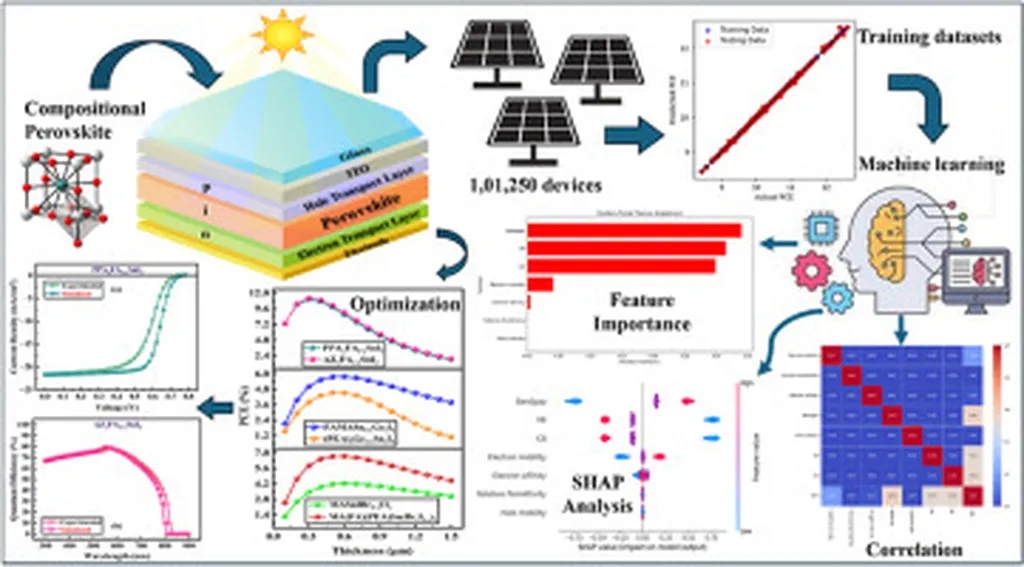
In the quest for sustainable and efficient solar energy solutions, researchers are turning to tin (Sn)-based perovskite solar cells (PSCs) as a promising lead-free alternative. However, these cells have faced significant challenges in achieving the same performance levels as their lead-based counterparts. A recent review published in the journal Sustainable Materials (SusMat), translated to English, sheds light on the key obstacles and potential breakthroughs in this field, offering a glimpse into the future of photovoltaic technologies.
The review, led by Padmini Pandey from the Department of Energy Systems Engineering at Chung-Ang University in Seoul, Republic of Korea, delves into the primary issues limiting the performance of Sn-based PSCs. “The main culprits are substantial open-circuit voltage (Voc) and fill factor (FF) losses,” Pandey explains. These losses stem from non-radiative recombination processes, which are exacerbated by undercoordinated Sn sites, deep-level defects, and the oxidation of Sn2+. These factors collectively elevate defect densities and accelerate recombination, thereby degrading the overall efficiency of the solar cells.
One of the critical challenges highlighted in the review is the degradation of the fill factor, which is linked to Shockley–Read–Hall (SRH) trap-assisted recombination. This phenomenon is reflected in increased ideality factors, further complicating the quest for high-performance Sn-based PSCs. “Matching the Voc and FF of Pb-based PSCs remains a significant challenge due to the intertwined effects of oxidation chemistry, defect physics, and interfacial energetics,” Pandey notes.
Despite these challenges, the review points to several advanced characterization approaches that are paving the way for better understanding and improvement of Sn-based PSCs. Techniques such as thermal admittance spectroscopy, drive-level capacitance profiling, and emerging machine-learning tools are proving invaluable in probing carrier dynamics and quantifying non-radiative pathways. These advancements are crucial for developing more efficient and sustainable photovoltaic technologies.
The review also highlights recent strategies that show promise in suppressing recombination and improving energy alignment. These include molecular coordination, surface passivation, compositional engineering, and optimized charge-transport interlayers. “Continued advances in defect passivation, oxidation control, and interface engineering are expected to be key to enabling efficient and environmentally sustainable Sn-based photovoltaic technologies,” Pandey emphasizes.
The implications of this research are significant for the energy sector. As the world shifts towards renewable energy sources, the development of efficient and sustainable solar cells is more critical than ever. Sn-based PSCs offer a viable alternative to lead-based cells, but their performance must be optimized to compete effectively in the market. The insights provided by Pandey and her team could shape future developments in the field, driving innovation and accelerating the adoption of sustainable photovoltaic technologies.
In conclusion, the review published in SusMat offers a comprehensive look at the challenges and opportunities in enhancing the performance of Sn-based PSCs. By addressing the root causes of Voc and FF losses and leveraging advanced characterization techniques, researchers are paving the way for a brighter, more sustainable future in solar energy. As the energy sector continues to evolve, the insights from this research will be instrumental in shaping the next generation of photovoltaic technologies.