
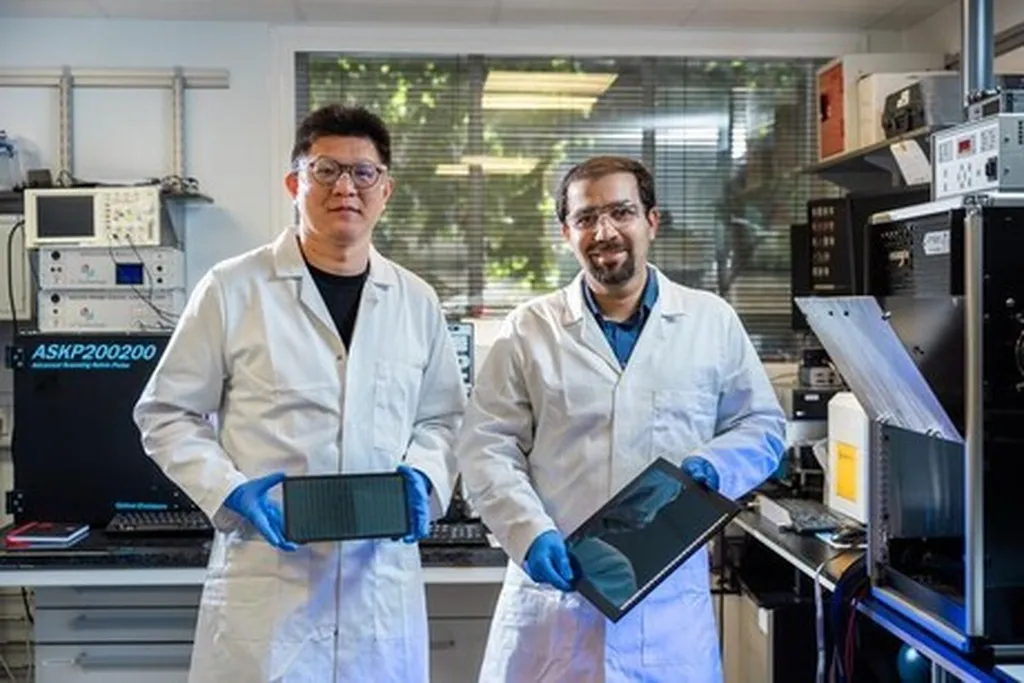
In the pursuit of cleaner and more efficient energy solutions, researchers are constantly exploring innovative materials to enhance solar cell technology. A recent study published in the journal *Materials Research Express* (which translates to “Materials Research Express” in English) has shed light on a promising candidate for next-generation perovskite solar cells (PSCs), offering a lead-free alternative that could significantly impact the energy sector.
The research, led by Kanij Fatema from the Department of Electrical & Electronic Engineering at Bangladesh University of Business and Technology in Dhaka, focuses on the inorganic titanium-based compound Cs2TiI6. This compound has emerged as a strong contender for third-generation PSCs, thanks to its non-toxic nature and efficient performance.
Using solar cell capacitance software (SCAPS-1D), Fatema and her team conducted a comprehensive investigation to optimize the inorganic Ti-based PSC under various conditions, including temperature, film thickness, energy gap, defect density, and carrier concentration. They also explored different structures by changing key factors such as electron transport materials (ETMs) and hole transport materials (HTMs).
The results were impressive. The highest efficiency was achieved with the structures TCO/SnO2/Cs2TiI6/CdTe/Pt and TCO/ZnO/Cs2TiI6/CdTe/Pt, respectively. At a temperature of 300 K, with an absorber layer band gap of 1.5 eV, a thickness of 700 nm, and a defect density of 10^11 cm^−3, the device demonstrated a power conversion efficiency (PCE) of approximately 30% and a quantum efficiency (QE) of 98% at a wavelength of 360 nm. Additionally, it achieved an open-circuit voltage (VOC) of 1.21 V, a short-circuit current density (JSC) of 30 mA cm^−2, and a fill factor (FF) of 88.6%.
“This research opens up new avenues for developing high-efficiency, lead-free perovskite solar cells,” said Fatema. “The potential commercial impacts are substantial, as it addresses both environmental concerns and the need for more efficient energy solutions.”
The findings suggest that Cs2TiI6 could play a pivotal role in the future of solar energy. By offering a non-toxic alternative to traditional lead-based perovskites, this research could accelerate the adoption of PSCs in the energy sector, making solar power more sustainable and widely accessible.
As the world continues to seek cleaner energy solutions, innovations like these are crucial. The study not only highlights the potential of Cs2TiI6 but also underscores the importance of ongoing research in materials science and solar technology. With further development, this technology could significantly contribute to a more sustainable energy future.
Fatema’s research, published in *Materials Research Express*, represents a significant step forward in the quest for efficient and environmentally friendly solar cells. As the energy sector continues to evolve, such advancements will be key to meeting global energy demands while minimizing environmental impact.