
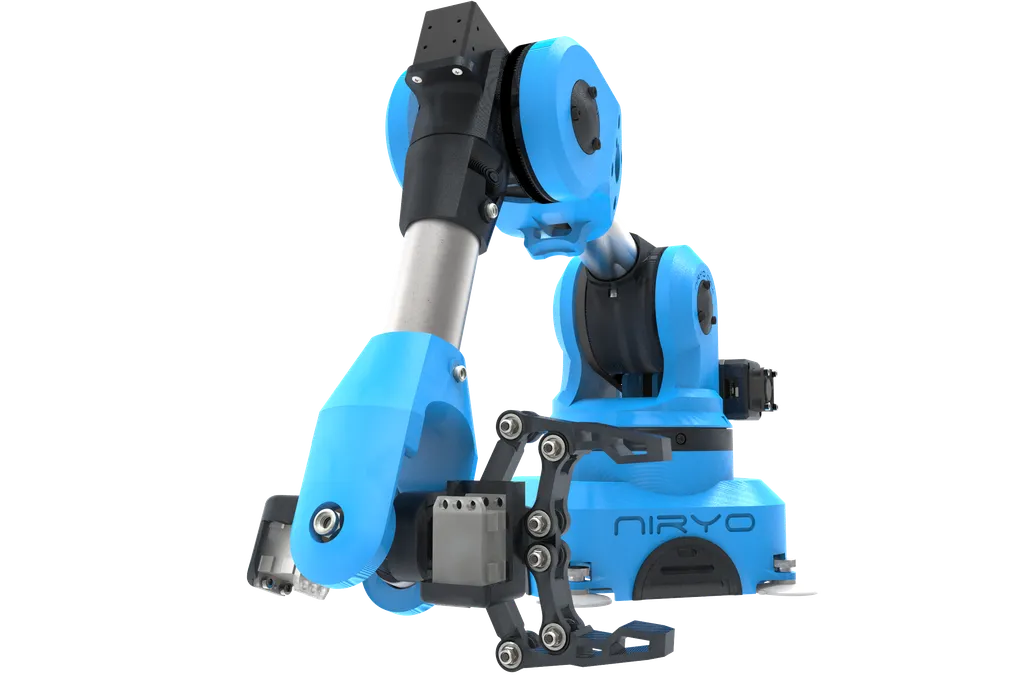
In the world of industrial robotics, efficiency and precision are paramount. A recent study published in the journal “Mining, Construction, Road and Melioration Machines” (Гірничі, будівельні, дорожні та меліоративні машини) by Dmytro Mishchuk of the Kyiv National University of Construction and Architecture is making waves with its innovative approach to optimizing the Niryo One robotic platform. The research, titled “Improving the Niryo One Robotic Platform through Optimization of Drive Operating Modes. Part II,” delves into the intricacies of enhancing robotic systems for industrial and research applications.
Mishchuk’s work focuses on developing a mathematical model of the manipulator’s dynamics, taking into account the unique construction and parameters of the Niryo One platform. “By understanding the dynamics of the manipulator, we can optimize its movement trajectories to achieve greater efficiency and precision,” Mishchuk explains. The study employs the Sequential Least Squares Programming (SLSQP) method to optimize these trajectories, aiming to minimize energy consumption and task execution time while adhering to system constraints.
The optimization process results in trajectories that reduce the load on the drives and improve the smoothness of movement compared to standard modes. Mishchuk notes, “Our approach ensures that the robotic system operates at its peak performance, reducing wear and tear on components and extending the overall lifespan of the platform.”
The implications for the energy sector are significant. Robotic systems that consume less energy and operate more efficiently can lead to substantial cost savings and reduced environmental impact. “In an industry where every watt counts, optimizing robotic systems can make a tangible difference,” Mishchuk adds.
The research also opens doors for future developments. Mishchuk envisions adapting the method for manipulators with different kinematic schemes and under varying external loads. “This is just the beginning. The potential applications of this research are vast, and we are excited to explore them further,” he says.
As the construction and energy sectors continue to evolve, the need for more efficient and reliable robotic systems becomes increasingly apparent. Mishchuk’s work represents a significant step forward in this direction, offering a glimpse into the future of industrial robotics. With the publication of this research, the industry is one step closer to achieving greater efficiency, reliability, and sustainability in robotic applications.