
In the quest for sustainable and high-performance air filtration solutions, a team of researchers has made a significant breakthrough by developing functional electrospun membranes derived from lignin, a renewable biopolymer. This innovation, led by Dawson Wai-Shun Suen from the Department of Construction, Environment & Engineering, promises to revolutionize the energy sector by offering an eco-friendly alternative to conventional filtration materials.
The study, published in the journal *Advances in Materials Science and Engineering* (which translates to *Advances in Materials Science and Engineering*), explores the fabrication of lignin-based nanofibrous membranes with antibacterial properties. By combining lignin with triclosan and synthetic polymers like poly(acrylonitrile) (PAN) and poly(vinylidene fluoride) (PVDF), the researchers created electrospun fibres that boast enhanced filtration and antibacterial performance.
“Our goal was to develop a sustainable and effective filtration material that could address the growing concerns about single-use polypropylene filters and microplastic generation,” said Suen. The membranes demonstrated remarkable filtration capabilities, achieving bacterial filtration efficiency (BFE) and particle filtration efficiency (PFE) of 99.9%. This high level of efficiency is attributed to the fine fibre structures and controlled pore sizes, which range from 0.05 to 0.209 micrometers in diameter and 0.01 to 0.178 micrometers in pore size, respectively.
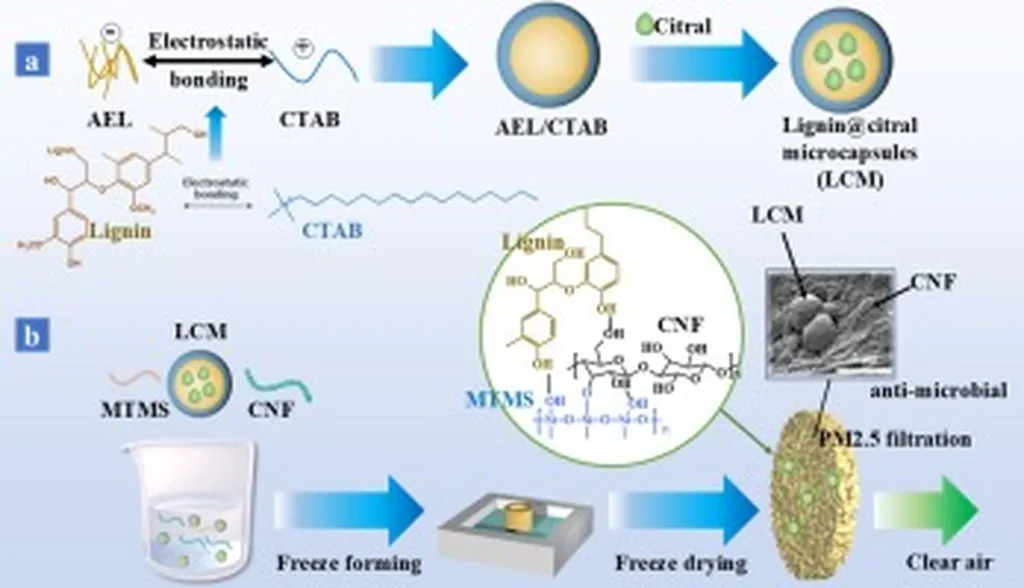
One of the key advantages of these lignin-based membranes is their strong antibacterial activity, with values exceeding A > 4 (ISO 20743). This indicates their ability to inhibit bacterial growth effectively, making them ideal for applications in clean air technologies. The addition of lignin not only improved fibre uniformity and mechanical stability but also enhanced the membranes’ adsorption capacity, enabling them to capture ultrafine particles, including viruses and PM2.5.
The commercial implications for the energy sector are substantial. As industries strive to meet sustainability goals and reduce their environmental footprint, the demand for eco-friendly and high-performance filtration materials is on the rise. Lignin-based membranes offer a promising solution, providing a biodegradable and efficient alternative to traditional filters.
“This research opens up new possibilities for the development of sustainable filtration technologies,” said Suen. “By leveraging renewable resources like lignin, we can create materials that are not only effective but also environmentally responsible.”
The findings of this study underscore the potential of lignin-based membranes to address critical environmental challenges. As the energy sector continues to evolve, the adoption of such innovative and sustainable solutions will be crucial in shaping a cleaner and more efficient future.
In summary, the development of lignin-based nanofibrous membranes represents a significant step forward in the quest for sustainable and high-performance air filtration solutions. With their exceptional filtration capabilities and antibacterial properties, these membranes offer a promising alternative to conventional filters, paving the way for a more eco-friendly and efficient energy sector.