
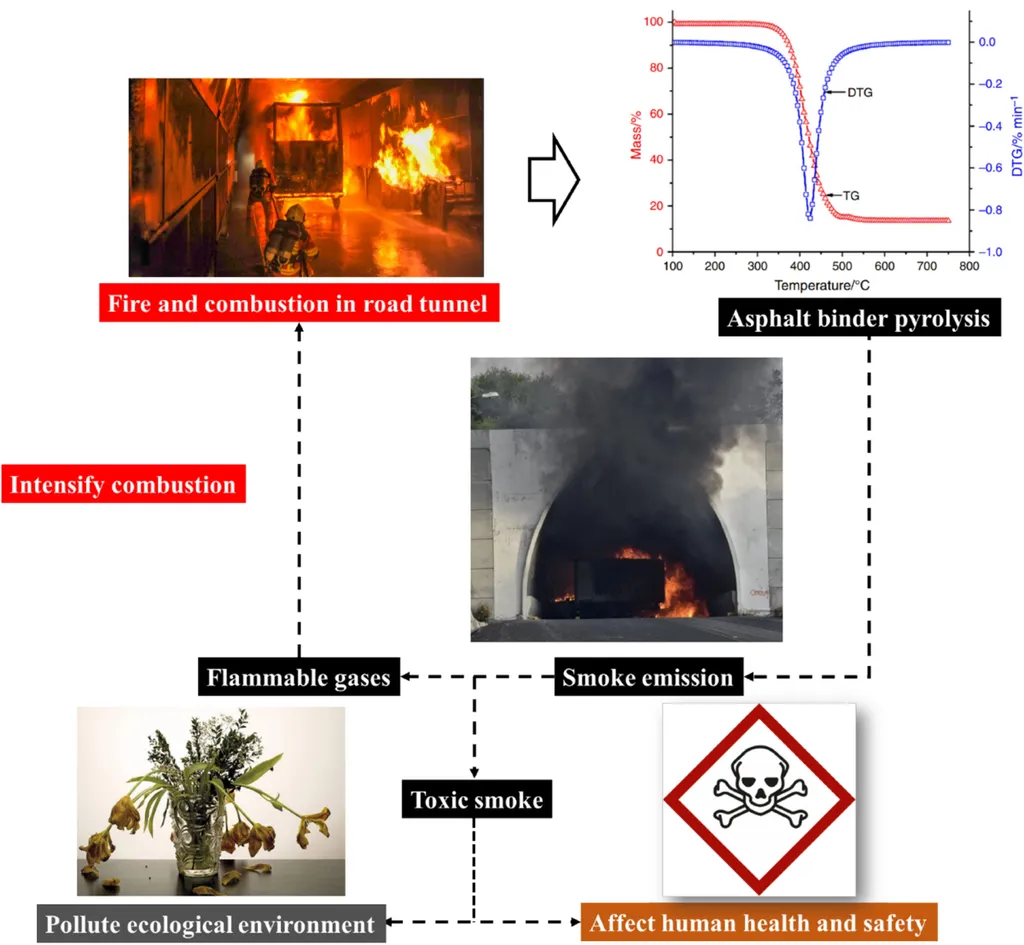
In the heart of China’s rapid infrastructure expansion, a critical question emerges: how can we make our tunnels safer? Yanxin Song, a researcher from Nanning Expressway Construction & Development Co., Ltd., has taken a significant step towards answering this question with a comprehensive study on flame retardant and smoke suppression technologies for asphalt, recently published in *Frontiers in Built Environment* (which translates to *Frontiers in Civil and Environmental Engineering*). As tunnel traffic infrastructure grows, so does the need for safer, more fire-resistant pavements. Song’s research delves into the combustion characteristics of asphalt, a staple in tunnel paving, and explores innovative ways to enhance its fire resistance.
Asphalt, while versatile and durable, is not inherently fire-resistant. Song’s study meticulously outlines the combustion process of asphalt and the mechanisms behind flame retardancy. “Understanding how asphalt burns is the first step in developing effective fire protection measures,” Song explains. The research categorizes various flame retardant technologies, from traditional additives to cutting-edge nanomaterials, each with unique mechanisms to suppress flames and reduce smoke.
One of the most promising advancements highlighted in the study is the use of nanomaterials. These tiny particles not only enhance the flame retardancy of asphalt by promoting char formation and catalytic oxidation but also help reduce volatile organic compound (VOC) emissions. “Nanomaterials offer a dual benefit,” Song notes, “they improve fire safety and contribute to a greener environment.”
The study also addresses the challenges in evaluating flame retardant performance. Current methods often rely on single indicators, which can lead to discrepancies in practical applications. Song’s research advocates for a more holistic approach, considering multiple factors to accurately assess the fire resistance of asphalt pavements.
The implications of this research for the energy sector are substantial. Safer tunnels mean more reliable infrastructure for transporting energy resources. Moreover, the development of green, high-performance asphalt materials aligns with the global push towards sustainability. As Song’s work paves the way for future advancements, it also underscores the need for further research in this critical area.
In the ever-evolving landscape of construction and energy, Song’s study serves as a beacon, guiding the industry towards safer, more sustainable solutions. As tunnel infrastructure continues to expand, the insights from this research will be invaluable in shaping the future of fire protection in transportation networks.