
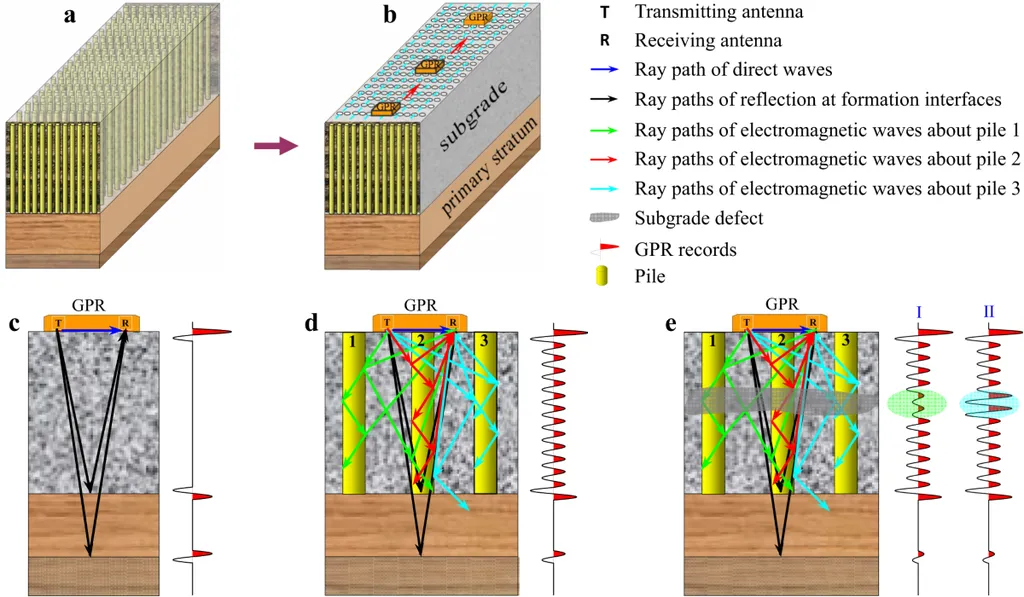
In the world of construction and infrastructure, ensuring the stability and safety of subgrade— the foundation layer of a road—is paramount. A recent study published in *Yantu gongcheng xuebao* (Chinese Journal of Geotechnical Engineering) by SHI Wenhao and colleagues from Suzhou University of Science and Technology and Kunshan Underground Space Technology Research Institute Co., Ltd., delves into the intricate world of soil-rock mixtures and their impact on subgrade void detection using ground-penetrating radar (GPR). This research could have significant implications for the energy sector, particularly in the maintenance and construction of pipelines, roads, and other critical infrastructure.
The study focuses on the response characteristics of GPR waves to voids in soil-rock mixed subgrades. To understand this better, the researchers built a microscopic model of soil-rock mixtures with pores, considering the randomness and non-uniformity of these mixtures. They employed a combination of random placement and random growth methods to create the model, with gravel particles modeled using an elliptical expansion deformation method. Using GprMax software, they conducted forward simulations of GPR waves in soil-rock mixed subgrades with voids.
“Our goal was to understand how different factors like gravel content, porosity, and moisture content affect the reflection signals of voids,” said SHI Wenhao, the lead author of the study. The results showed that electromagnetic waves are strongly reflected when they encounter voids, but the scattering of these waves in soil-rock mixtures can make the signals blurry and the wave surface uneven.
The study found that larger gravel particles cause more distortion in the reflected waves, reducing their distinguishability. Interestingly, an appropriate amount of gravel can enhance the amplitude of cavity signals, but exceeding a certain threshold leads to signal attenuation. Porosity and moisture content primarily affect the reflection signals of voids through the dielectric constant.
This research is crucial for the energy sector, where understanding the stability of subgrades is vital for the safe and efficient operation of infrastructure. For instance, in the construction of pipelines, knowing how voids affect the subgrade can help prevent potential failures and ensure the integrity of the pipeline. Similarly, in road construction, this knowledge can lead to better maintenance practices and improved safety.
The findings also open up new avenues for future research. As SHI Wenhao noted, “This study provides a theoretical basis for the recognition of GPR images of voids in soil-rock mixed subgrades. Future work could explore more advanced modeling techniques and real-world applications to further validate these findings.”
In conclusion, this research offers valuable insights into the behavior of GPR waves in soil-rock mixtures, with significant implications for the energy sector. By understanding the factors that influence the reflection signals of voids, engineers and researchers can develop more effective strategies for maintaining and constructing critical infrastructure. The study, published in *Yantu gongcheng xuebao* (Chinese Journal of Geotechnical Engineering), marks a significant step forward in this field, paving the way for future advancements.