
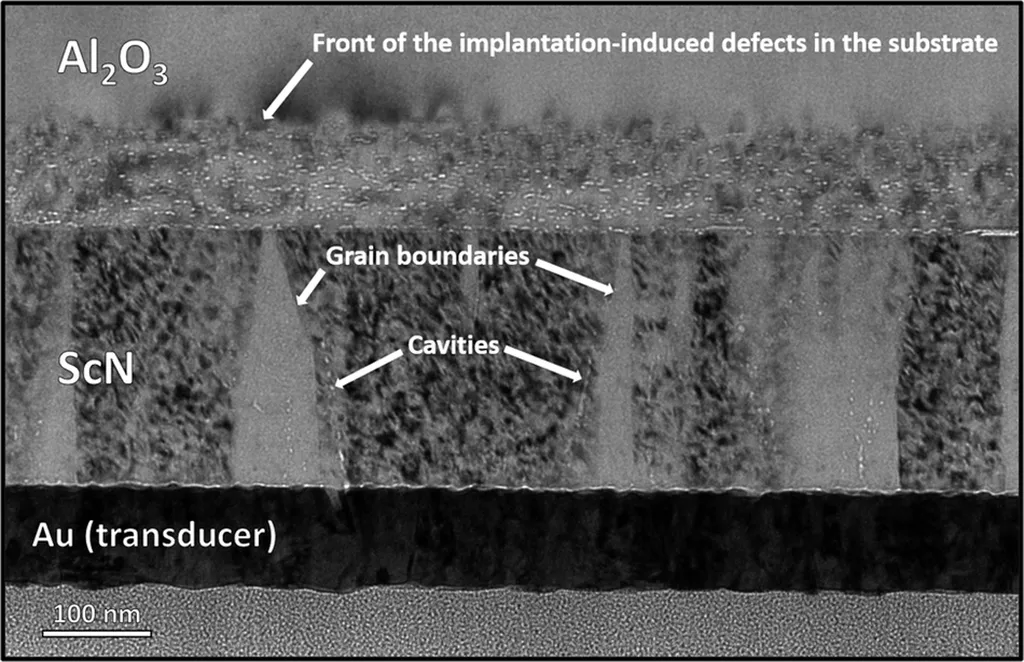
In the quest for more efficient energy conversion, scientists are turning to the microscopic world of materials science, seeking to unlock the secrets of thermoelectricity. A recent study published in the journal ‘Applied Surface Science Advances’ (or in English, ‘Advances in Applied Surface Science’) by Luigi Cigarini of IT4Innovations at VŠB – Technical University of Ostrava, is shedding new light on how defects and impurities in scandium nitride can significantly influence its thermoelectric properties. This research could pave the way for more efficient energy harvesting and waste heat recovery, with profound implications for the energy sector.
Thermoelectric materials have the remarkable ability to convert heat directly into electricity, and vice versa. This property makes them highly attractive for applications such as waste heat recovery in industrial processes, automotive exhaust systems, and even powering small electronic devices. However, the efficiency of these materials is often limited by their electronic transport properties, which can be highly sensitive to structural defects and impurities.
Cigarini and his team employed the Landauer approach, a quantum mechanical method, to analyze the effects of different kinds of structural defects and impurities on electronic transport in scandium nitride. “This approach allows us to relate the transport mechanisms to the structural and electronic modifications introduced in the lattice, with atomistic resolution,” Cigarini explains. By doing so, they were able to gain unprecedented insights into how microscopic features affect macroscopic transport properties.
The study revealed that the thermoelectric properties of scandium nitride are strongly influenced by the presence of defects and impurities. These imperfections can either enhance or hinder electronic transport, depending on their nature and concentration. “We found that certain types of defects can significantly improve the thermoelectric efficiency, while others can have a detrimental effect,” Cigarini notes. This new understanding could help researchers design and engineer materials with optimized thermoelectric properties, leading to more efficient energy conversion devices.
The findings also shed light on the large variability observed in experimental measurements of thermoelectric properties. “Our results suggest that part of this variability can be attributed to the presence of different types of defects and impurities in the samples,” Cigarini says. By controlling these microscopic features, researchers could potentially reduce the variability and improve the reliability of thermoelectric devices.
The implications of this research extend beyond scandium nitride. The insights gained from this study could be applied to other thermoelectric materials, opening up new avenues for exploration and innovation. As the world seeks to transition towards a more sustainable energy future, the development of efficient thermoelectric devices could play a crucial role in harnessing waste heat and reducing our reliance on fossil fuels.
In the words of Cigarini, “This work is a step towards understanding and controlling the microscopic factors that govern the thermoelectric properties of materials. By doing so, we can pave the way for the development of more efficient and reliable thermoelectric devices, with significant benefits for the energy sector.” As researchers continue to delve into the microscopic world of materials science, the future of thermoelectricity looks brighter than ever.