
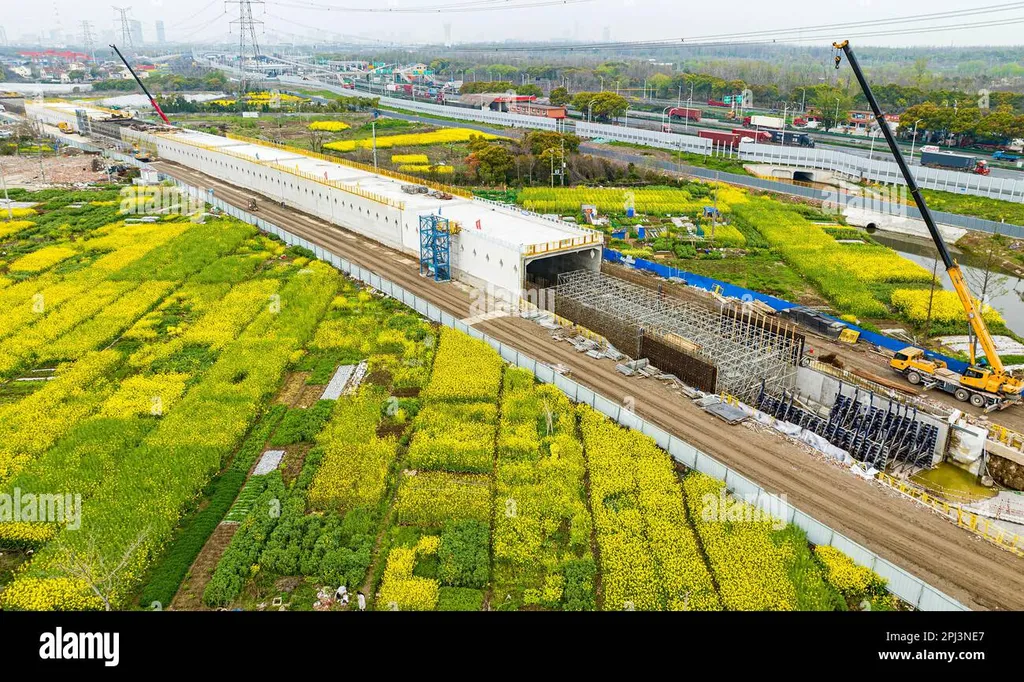
In the heart of Shanghai, researchers are turning the city’s notorious soft soil into a canvas for innovation, and their latest findings could reshape how we approach deep underground construction. A team led by LIU Shujia from the Shanghai Construction Management Vocational and Technical College, in collaboration with LIAO Shaoming and MA Xianfeng from Tongji University, has been delving into the mysteries of shield tunneling in deep soft soil strata. Their work, published in *Yantu gongcheng xuebao* (translated to *Chinese Journal of Geotechnical Engineering*), offers a fresh perspective on how to optimize tunneling techniques for the energy sector and beyond.
The team’s centrifuge experiments simulated the entire process of excavation and long-term creep of deep buried shield tunnels in soft soil. By subjecting their models to varying gravity accelerations—50g, 70g, and 90g—they mimicked medium, deep, and ultra-deep burial conditions. “We wanted to understand how different burial depths and excavation methods affect soil arching and face pressure,” explains LIU Shujia. “This is crucial for predicting long-term stability and safety in deep soil layers.”
Their findings are nothing short of transformative. When excavating in deep soft soil layers (4D or deeper), using an unloading excavation mode can reduce the long-term soil pressure borne by the shield machine and pipe segments by about 20% after two years. Conversely, adopting an excavation mode that adds soil pressure increases the long-term soil pressure maintained by the tunnel segments by about 20% compared to static soil pressure.
For the energy sector, these insights are invaluable. As we push the boundaries of underground infrastructure, from deep geothermal energy projects to complex urban tunneling, understanding soil behavior is paramount. “Our research provides time-sensitive data that can guide engineers in choosing the most effective excavation methods for deep soft soil formations,” says LIAO Shaoming. “This can lead to more efficient, safer, and cost-effective tunneling projects.”
The implications are far-reaching. By optimizing excavation methods, energy companies can minimize disturbances to the surrounding soil, reducing the risk of subsidence and other geological hazards. This is particularly relevant for projects involving deep soil layers, where the long-term stability of tunnels is critical.
As the world continues to explore underground spaces for energy solutions, the work of LIU, LIAO, and MA offers a beacon of innovation. Their research not only advances our understanding of soil mechanics but also paves the way for more resilient and efficient underground construction. In a field where every detail counts, their findings are a testament to the power of meticulous experimentation and collaborative research.
In the words of MA Xianfeng, “This is just the beginning. Our work opens up new avenues for exploring the complexities of deep soil tunneling, and we are excited to see how these insights will shape the future of underground engineering.” With their groundbreaking research, the future of deep soil tunneling looks brighter—and more stable—than ever.