
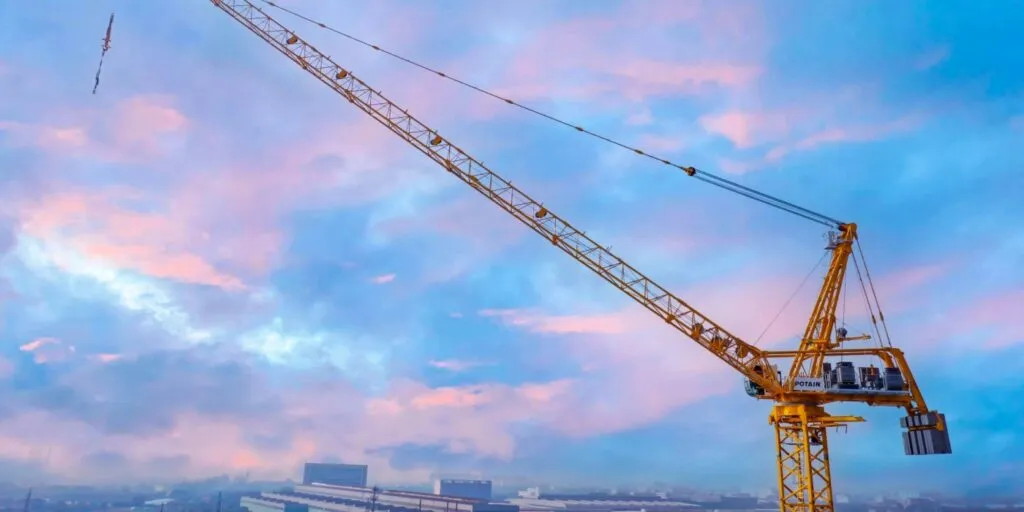
In the bustling world of construction and heavy machinery, efficiency and safety are paramount. A recent study published in the journal *Mining, Construction, Road and Reclamation Machines* (Гірничі, будівельні, дорожні та меліоративні машини) tackles these very issues, focusing on the optimal movement of loads using tower cranes. Led by Yuriy Romasevych from the National University of Life and Environmental Sciences of Ukraine, the research delves into the dynamics of crane operations, offering insights that could revolutionize the way we approach construction projects, particularly in the energy sector.
The study addresses a critical challenge: how to synthesize optimal trajectories for moving loads with tower cranes to enhance both productivity and safety. Romasevych and his team developed a dynamic model that considers the crane’s jib, trolley, and the suspended load, accounting for the pendulum-like swings that occur during movement. “We aimed to determine the laws of motion for the jib and trolley that ensure the load follows a desired trajectory,” Romasevych explains. This involves solving an inverse kinematics problem, a complex task that requires balancing multiple variables.
One of the key innovations in this research is the application of an optimization approach to minimize the duration of load transport while adhering to kinematic and dynamic constraints. This includes limiting the maximum speeds of the trolley and the rotation of the jib. To ensure smooth movement and reduce dynamic loads, the team employed regularization methods, which help mitigate the amplitude of load swings and prevent undesirable changes in the direction of the mechanisms.
The researchers used a modified particle swarm optimization method (VCT-PSO) to solve the optimization problem, demonstrating its effectiveness in finding optimal trajectory parameters. The study also analyzed the impact of regularization and the length of the flexible suspension on the system’s dynamic characteristics, including swing amplitude, peak forces, and moments, as well as the duration of movement. “Our results show that using regularization significantly reduces dynamic loads and enhances the stability of the movement, although it may increase the transport time,” Romasevych notes. Conversely, shortening the suspension length reduces the movement time but can increase the swing amplitude.
The research introduces a new tool for analyzing system dynamics in terms of deviation coordinates and speed differences, providing a clear evaluation of the oscillatory process and confirming the fulfillment of boundary conditions. These findings could have profound implications for the energy sector, where tower cranes are frequently used in the construction of power plants, wind farms, and other large-scale projects. By optimizing the movement of loads, construction companies can reduce downtime, improve safety, and ultimately lower costs.
Romasevych’s work not only advances our understanding of crane dynamics but also paves the way for more efficient and safer construction practices. As the energy sector continues to grow and evolve, the insights gained from this research could play a crucial role in shaping future developments in heavy machinery and construction technology. The study serves as a testament to the power of innovative thinking and the potential for significant improvements in the field.