
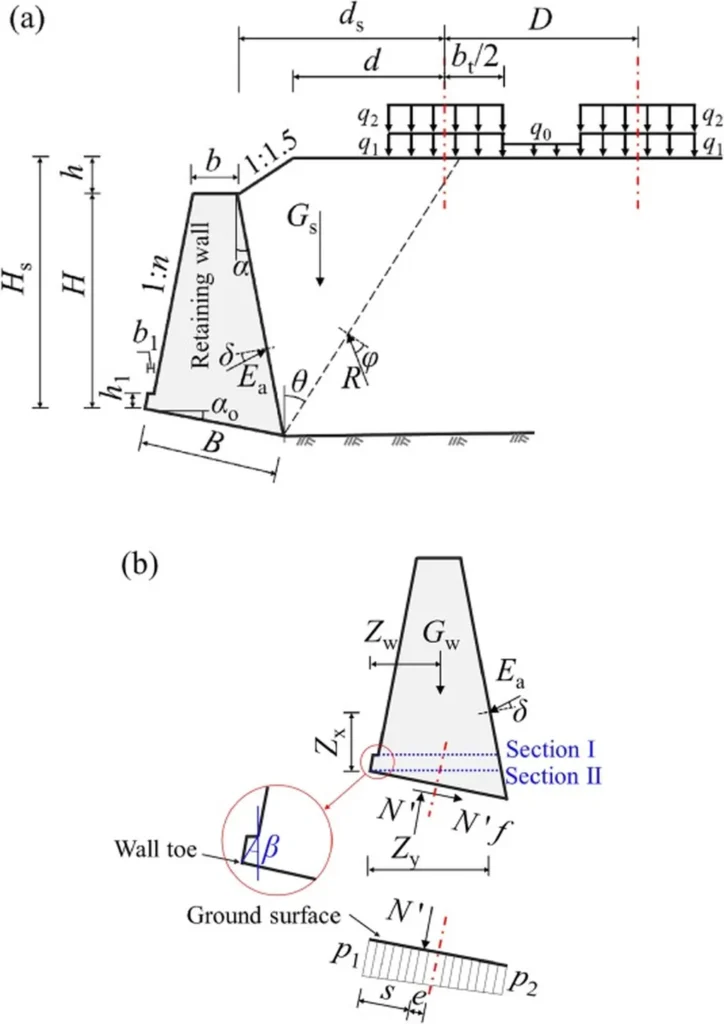
In the realm of railway infrastructure, the stability of retaining walls is paramount, and a recent study published in *Yantu gongcheng xuebao* (Chinese Journal of Geotechnical Engineering) offers a promising new method for calculating active earth pressure in gravity retaining walls of railway subgrades. Led by Dr. Li Bin from the Department of Road and Bridge Engineering at Wuhan University of Technology, the research addresses a critical gap in current engineering practices.
Traditional methods, based on Coulomb earth pressure theory, often fall short when applied to the complex conditions behind railway subgrade gravity retaining walls. The cross-section of the backfill is trapezoidal and subjected to dynamic train loads, making it difficult to determine the location of dangerous sliding surfaces and the magnitude of active earth pressure. This complexity hampers the stability analysis of retaining walls, a crucial aspect of railway construction and maintenance.
Dr. Li Bin and his team, including collaborators from Southwest Jiaotong University and China Railway Engineering Consulting Group Co., Ltd., have developed a novel approach to tackle this challenge. Their method involves determining dangerous sliding surfaces based on the limit equilibrium of sliding soil and calculating the active earth pressure resultant force. By applying the principles of equivalent resultant force and equivalent total moment, the researchers can accurately determine the force arms of the horizontal and vertical components of active earth pressure.
“The proposed method achieves high accuracy with a simple calculation principle, less computational demand, and fewer constraints,” said Dr. Li Bin. “It is recommended to have a step size of 0.5° for the inclination angle change of the sliding surface to ensure high accuracy and efficiency simultaneously.”
The study also performs stability analysis considering two failure modes: sliding and overturning. The results demonstrate the effectiveness of the new method, which could significantly improve the safety and reliability of railway subgrade gravity retaining walls.
The research further analyzes the impact of various parameters, such as the distribution and width of the overload, the inclination angle of the wall back, and the angle of the inner slope. By summarizing the influence patterns of these parameters, the study provides valuable insights into the magnitude of active earth pressure, the position of active earth pressure, and the safety of different failure modes.
The implications of this research extend beyond railway infrastructure. In the energy sector, where retaining walls are often used in the construction of pipelines, power plants, and other critical infrastructure, the ability to accurately calculate active earth pressure and assess stability is crucial. The method developed by Dr. Li Bin and his team could lead to more robust and cost-effective designs, reducing the risk of failures and enhancing the overall safety of energy projects.
As the demand for reliable and efficient transportation and energy infrastructure continues to grow, innovations like this one play a vital role in shaping the future of the construction industry. By providing a more accurate and efficient way to analyze the stability of retaining walls, this research paves the way for safer and more sustainable developments in both the railway and energy sectors.
The study, published in *Yantu gongcheng xuebao*, translates to the *Chinese Journal of Geotechnical Engineering*, underscores the importance of international collaboration and knowledge sharing in advancing the field of geotechnical engineering. As Dr. Li Bin and his team continue their work, the industry can look forward to further breakthroughs that will drive progress and innovation in the years to come.