
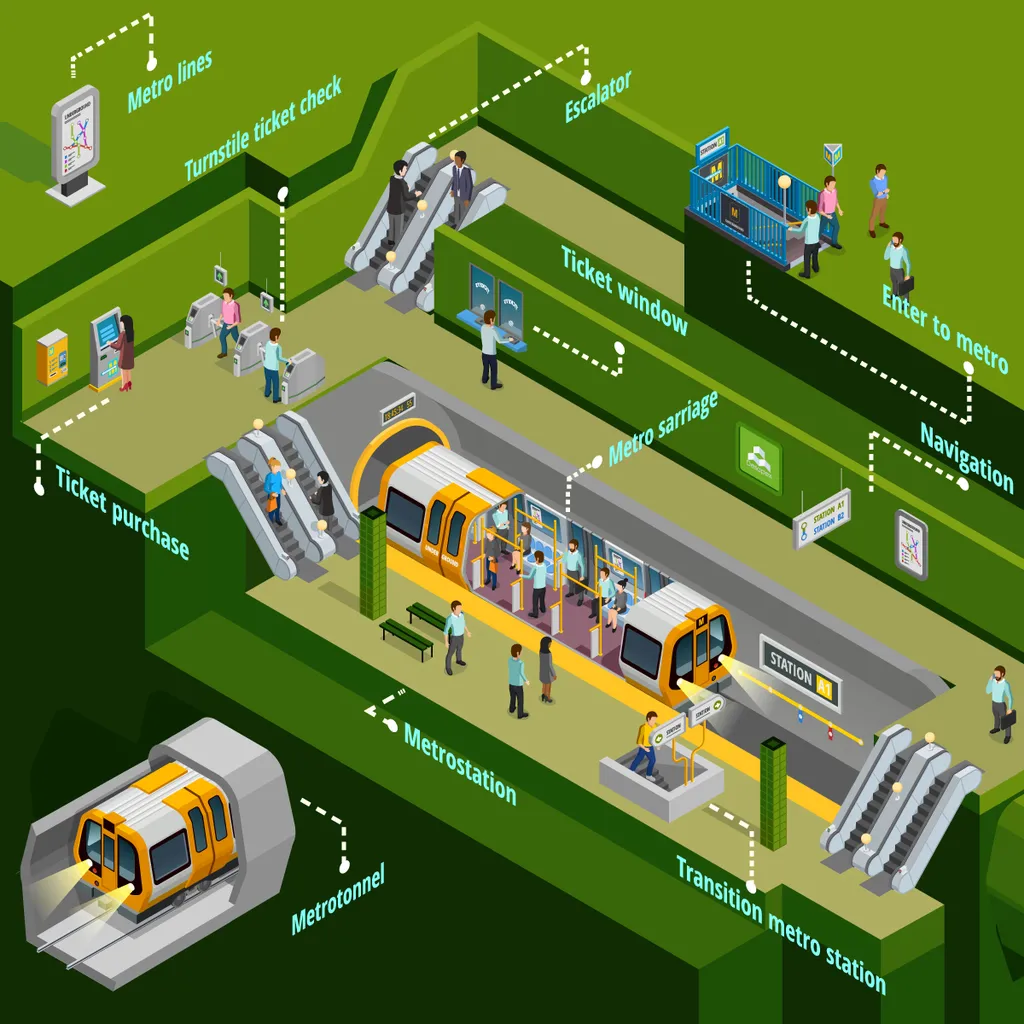
In the bustling world of urban rail transit, a groundbreaking method is poised to revolutionize how metro stations and lines are designed and integrated. Researchers, led by Xikui Lyu from the Key Laboratory of Traffic Safety and Control in Hebei Province, have developed a Building Information Modeling (BIM)-based integrated 3D modeling technique that promises to streamline the construction process and enhance the precision of metro station designs. This innovation, published in *Chengshi guidao jiaotong yanjiu* (Urban Rail Transit Research), addresses long-standing challenges in the industry, offering a glimpse into a more efficient and interconnected future.
The traditional approach to BIM modeling of complex metro stations has been fraught with difficulties, including cumbersome operations, inaccurate component parameters, and models that fail to meet interactive application requirements. Lyu and his team recognized the need for a more automated and precise method to rapidly create BIM models based on design data. “Our goal was to develop a method that not only simplifies the modeling process but also ensures seamless integration between station and line models,” Lyu explained.
The researchers established a database of metro station component design parameters and constraint rules, which serves as the foundation for their innovative approach. By developing a spatial coordinate set and rotation azimuth calculation algorithm, they enabled precise positioning and automatic orientation adjustment of station models. This method allows for the automatic supplementation and creation of line solid models in the connecting sections between stations and lines, addressing key technical issues in the station-line splicing process.
Using C# language and Revit API secondary development technology, the team created a general modeling system for parametric and rule-constrained metro stations. This system forms parameter sets through inter-constraints among unit parameters, enabling rapid construction of rule-compliant models for metro station main structures, auxiliary facilities, specialized equipment, and track lines. “The system’s ability to form parameter sets through inter-constraints allows for a more efficient and accurate modeling process,” Lyu noted.
The proposed method enables a BIM-based rapid creation of metro station and line integrated models, resolving core issues in metro station modeling such as geometric size parameterization, rule standardization, interactive adjustment, and spatial layout interconnectivity. This innovation has significant commercial implications for the energy sector, particularly in urban planning and infrastructure development. By enhancing the precision and efficiency of metro station designs, this method can lead to reduced construction costs, improved safety, and better resource management.
The research conducted by Lyu and his team is a significant step forward in the field of urban rail transit. As cities continue to grow and expand, the demand for efficient and reliable public transportation systems will only increase. This innovative BIM-based modeling method offers a promising solution to meet these demands, paving the way for smarter, more interconnected urban infrastructure. The publication of this research in *Urban Rail Transit Research* underscores its relevance and potential impact on the industry, setting a new standard for future developments in metro station and line integration.