
In the heart of Italy, at the University of Salerno, a groundbreaking study led by Sara Antinozzi is reshaping the future of construction project management. Antinozzi, a researcher in the Department of Civil Engineering, has been exploring the integration of Building Information Modelling (BIM) with blockchain technology and smart contracts, aiming to revolutionize how information and contracts are managed in construction projects.
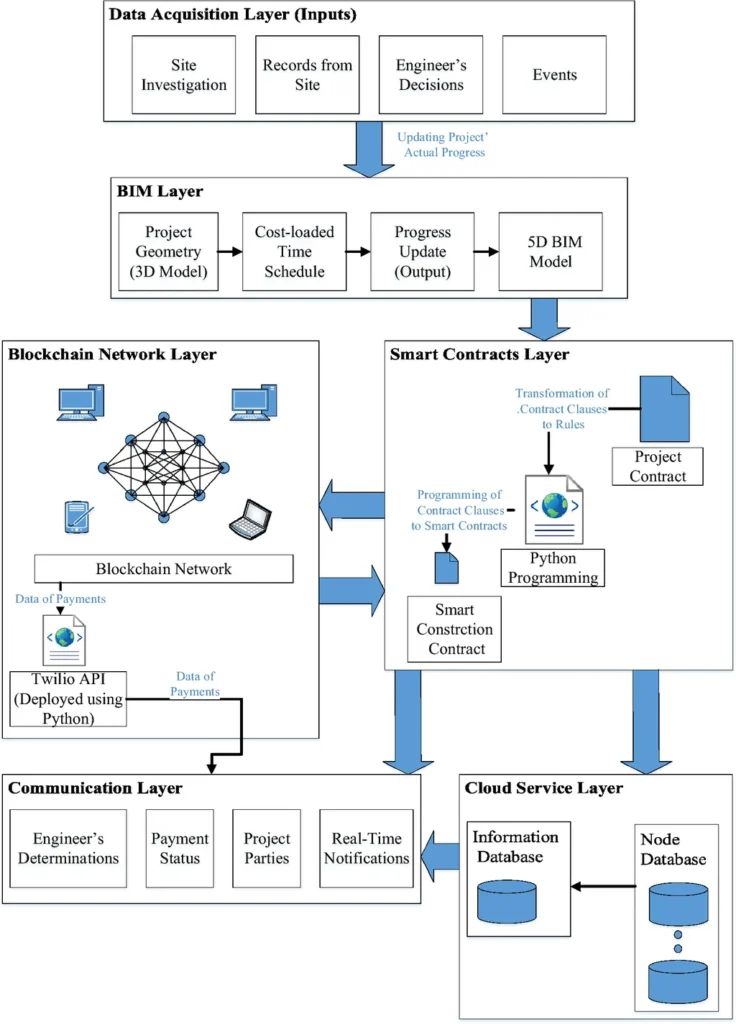
The research, published in the journal *Applied Sciences* (which translates to *Applied Sciences* in English), introduces a decentralized system that combines BIM models, decentralized storage via the InterPlanetary File System (IPFS), semantic oracles, and smart contracts. This innovative approach automates critical processes such as versioning, design verification, and payment issuance based on project milestones.
Antinozzi’s proof of concept, built on a Proof-of-Authority blockchain using real Industry Foundation Classes (IFC) models, demonstrates the technical feasibility of the method. The study evaluates its performance, limitations, and operational implications, highlighting the potential to reduce uncertainty and enhance accountability in construction projects.
One of the most compelling aspects of this research is the automation of design review and payment processes. “Integrating off-chain verification with on-chain documentation can significantly reduce uncertainty and enable new forms of contract automation,” Antinozzi explains. This integration not only streamlines project management but also opens up new possibilities for the energy sector, where construction projects often involve complex contracts and large-scale collaborations.
The implications for the energy sector are substantial. Construction projects in this field often require meticulous coordination among multiple stakeholders, from engineers to contractors. The decentralized BIM workflow proposed by Antinozzi could ensure that all parties have access to the most up-to-date information, reducing the risk of errors and delays. Moreover, the automation of payment issuance based on project milestones could improve cash flow and financial transparency.
Antinozzi’s research also acknowledges the need for improved information standards and Oracle governance. “The suggested framework demonstrates that integrating BIM and distributed technologies can significantly transform the digitalization of the construction sector,” she notes. This transformation could lead to more efficient, transparent, and accountable construction projects, ultimately benefiting the energy sector and beyond.
As the construction industry continues to evolve, the integration of BIM with blockchain technology and smart contracts could become a standard practice. Antinozzi’s research paves the way for future developments, offering a glimpse into a future where construction projects are managed more efficiently and transparently. The energy sector, in particular, stands to gain from these advancements, as it navigates the complexities of large-scale construction projects.
In the words of Antinozzi, “This is just the beginning. The potential for further innovation in this field is immense.” As the construction industry embraces these technologies, the future of project management looks brighter than ever.