
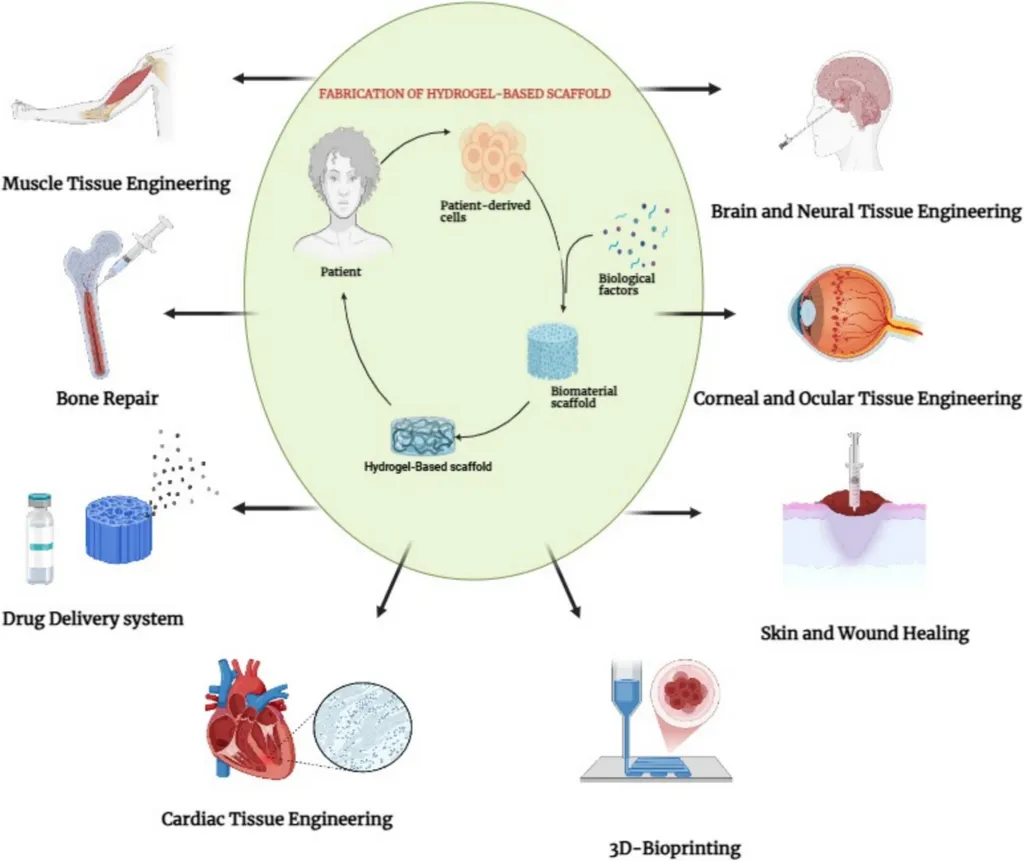
In the bustling world of biomedical materials, a new player has emerged, promising to revolutionize tissue engineering and light-based biofabrication. Researchers, led by Isabela Lima Autran Dourado from the Departamento de Química Fundamental at the Universidade de São Paulo, Brazil, have developed a novel, biodegradable polyester derived from panthenol, a cofactor known for its moisturizing and wound-healing properties. This innovative material, poly(D,L-4,3′-panthenyl adipate) or PPA, could potentially reshape the landscape of biomedical applications, offering a safe and tunable platform for complex tissue regeneration.
The team’s research, recently published in *Materials Today Advances* (which translates to *Advanced Materials Today*), introduces a unique approach to creating degradable materials that support intricate tissue architectures. “We’ve successfully synthesized and modified PPA, enabling us to photo-crosslink it with a variety of co-monomers,” Dourado explains. “This allows us to tailor the network properties to specific needs, opening up a world of possibilities for biomedical applications.”
The key to this innovation lies in the acrylate modification of PPA, which introduces acryloyl moieties and enables photo-crosslinking. This process allows for the incorporation of diverse co-crosslinkers, each with unique reactivities and functional groups. As a result, the team achieved high network densities with rapid gelation kinetics and full double bond conversion, demonstrating exceptional efficiency in photo-curing.
One of the most significant aspects of this research is the tunable degradation rates of the developed systems. “Our materials are hydrolytically degradable, and we can control the degradation rate to suit different applications,” Dourado notes. This feature, combined with the non-cytotoxicity of the systems towards NIH-3T3 cell lines, makes them promising candidates for light-based scaffold biofabrication techniques.
The potential commercial impacts of this research are substantial. In the energy sector, for instance, these materials could be used to develop advanced, biodegradable components for medical devices and implants, reducing waste and environmental impact. Moreover, the ability to functionalize panthenol-derived polymers with different unsaturated groups unlocks exciting possibilities for future biomedical applications.
As the demand for safe, biodegradable materials in tissue engineering continues to grow, this research offers a compelling solution. By harnessing the power of photo-crosslinking and the unique properties of panthenol, Dourado and her team have paved the way for innovative developments in the field. Their work not only advances our understanding of panthenyl-polymers but also brings us one step closer to realizing the full potential of light-based biofabrication techniques.