
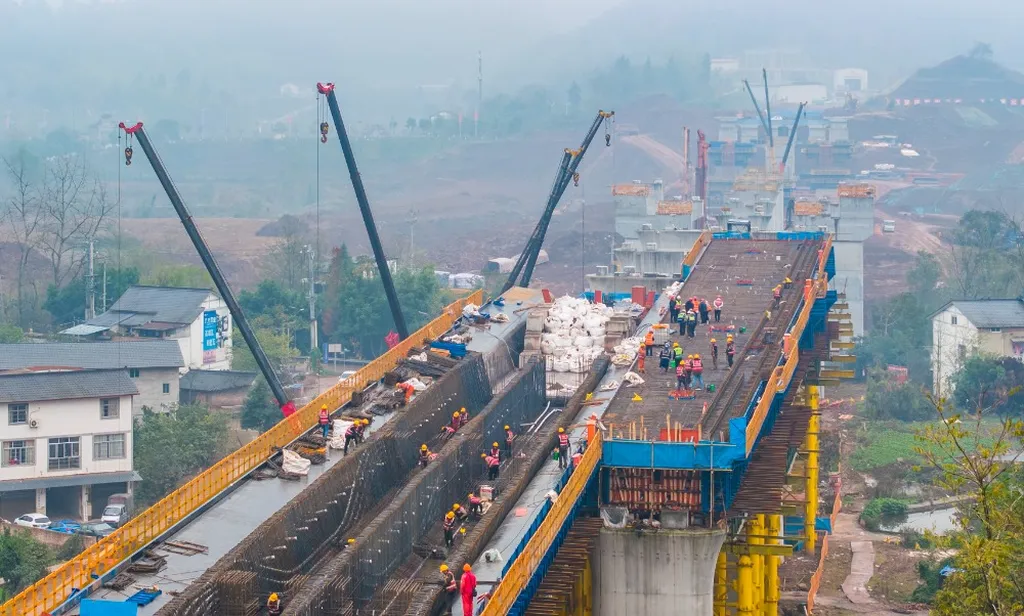
In the heart of bustling urban centers, where space is at a premium and high-rise structures tower above, deep excavation projects pose significant challenges. The delicate balance between progress and preservation is a tightrope walk that engineers and developers must navigate carefully. A recent study, led by Xiaohui Xie of Chongqing Chuanjiu Mine Construction Co. Ltd., published in the journal *Advances in Civil Engineering* (translated from Chinese), sheds new light on the best practices for controlling structural deformation in these high-stakes environments.
The research, titled “Analysis of Structural Deformation Control Schemes and Sensitivity Parameters for Deep Excavation in Urban Core Areas,” focuses on three support schemes: retaining piles with internal bracing (RPIB, Scheme A), double-row piles (DRP, Scheme B), and a pile-anchor system (PAS, Scheme C). The study’s findings could have profound implications for the construction and energy sectors, particularly in urban core areas where deep excavations are often necessary for infrastructure development.
Xie and his team conducted computational modeling and field monitoring to evaluate the performance of these schemes near a sensitive high-rise building. The results were striking. Scheme A, which uses retaining piles with internal bracing, demonstrated superior performance in controlling deformation. “Building settlement was effectively limited to 18.41 mm, and the building tilt ratio was controlled within 0.073%,” Xie explained. “This meets the requirements of design specifications and safety control standards.”
The study also revealed that the horizontal displacement of the support structure in Scheme A conforms to a Gaussian distribution, a finding that could revolutionize predictive modeling in the field. “The magnitude of displacement varying with depth can be predicted using Gaussian Equations (3) and (4),” Xie noted. This predictive capability could significantly enhance the accuracy of future excavation projects, reducing risks and costs.
In contrast, Schemes B and C exhibited risks of stability failure at excavation depths exceeding 12 meters due to insufficient structural system stiffness. This highlights the critical importance of choosing the right support scheme for deep excavations in urban areas.
The research also included a sensitivity analysis of the key parameters of Scheme A, quantifying the influence trends of various support parameters on building deformation. This analysis identified the optimal parameter combination for implementing Scheme A in deep excavations within urban core zones. By comparing the original support scheme with the optimized support scheme, the study demonstrated that the optimized scheme could reduce building settlement and horizontal displacement by 50.2% and 24.3%, respectively.
The implications for the construction and energy sectors are substantial. As urbanization continues to accelerate, the demand for deep excavation projects in core urban areas will only increase. The findings of this study provide a robust framework for enhancing the safety and efficiency of these projects, ultimately reducing costs and mitigating risks.
“Our research provides theoretical and technical references for deep foundation pit support design and the control of structural deformation during construction in urban core areas,” Xie stated. This could pave the way for more ambitious and innovative projects in the future, shaping the skylines of our cities and the infrastructure that supports them.
As the construction industry continues to evolve, the insights gained from this study will be invaluable. By embracing these findings, developers and engineers can ensure that their projects not only meet the highest standards of safety and efficiency but also contribute to the sustainable growth of our urban environments. The publication of this research in *Advances in Civil Engineering* underscores its significance and relevance to the global construction community.