
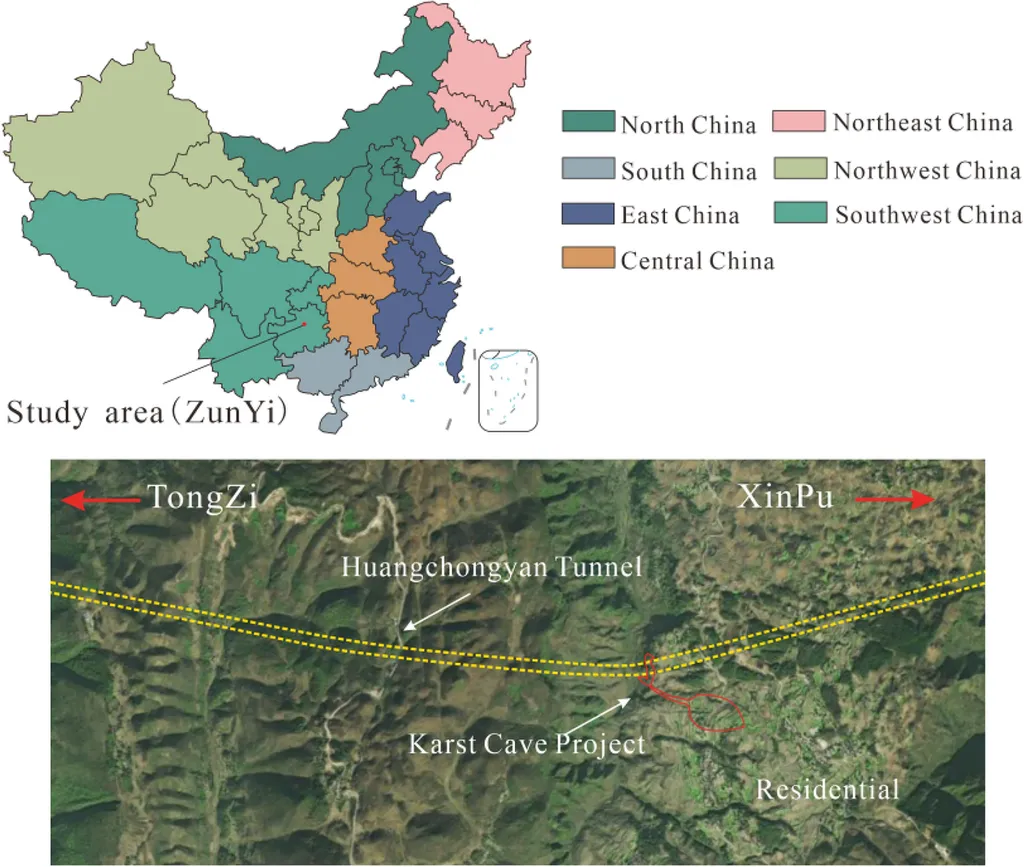
In the heart of Southwest China, where karst landscapes dominate and airports hum with activity, a groundbreaking study is shedding light on the delicate dance between tunnel construction and surface subsidence. Led by Yong Liu from the Science and Technology Research Institute, this research is not just about understanding the ground beneath our feet; it’s about ensuring the safety and efficiency of critical infrastructure in sensitive environments.
The study, published in the *Advances in Civil Engineering* (translated from Chinese as “Advances in Civil Engineering”), focuses on the construction of subsurface karst tunnels near airports. These tunnels, while essential for transportation and utilities, pose significant risks due to the complex geological conditions and the proximity to airports. Surface subsidence, a common issue in karst regions, can jeopardize both tunnel construction safety and airport operations.
Liu and his team employed a multi-faceted approach to tackle this challenge. They began by analyzing the geological characteristics of the area to determine the optimal test scheme for cantilever tunneling machine excavation. This method, combined with numerical simulation, allowed them to predict and monitor subsidence more accurately.
One of the key findings of the study is that the subsidence deformation characteristics conform to the Peck formula, a widely accepted model in geotechnical engineering. This conformity provides a solid foundation for predicting and managing subsidence in similar projects.
“The subsidence curves of multiple sections show a universal four-stage pattern: rapid deformation, slow deformation, deformation acceleration, and deformation convergence,” Liu explained. This pattern is crucial for understanding the spatiotemporal evolution of surface subsidence and for developing effective mitigation strategies.
The study also revealed that the subsidence amount varies significantly depending on the excavation stage. The largest subsidence occurs during the excavation of the upper step, while the smallest occurs during the excavation of the lower step to the section. This information is invaluable for planning and executing tunnel construction in karst areas.
The implications of this research extend far beyond the immediate project. By providing a direct basis for settlement prediction and dynamic adjustment, it offers a roadmap for ensuring the safety and efficiency of tunnel construction in karst regions. This is particularly relevant for the energy sector, where the construction of pipelines, transmission lines, and other infrastructure often involves tunneling in challenging geological conditions.
As the world continues to invest in infrastructure development, the need for safe and efficient tunneling methods will only grow. This study, with its comprehensive analysis and practical recommendations, is a significant step forward in meeting that need.
In the words of Liu, “Our findings provide important practical significance for ensuring airport operational safety and offer a direct basis for settlement prediction and dynamic adjustment in similar tunnel constructions in karst areas.” This research is not just about understanding the ground beneath our feet; it’s about building a safer, more efficient future.