
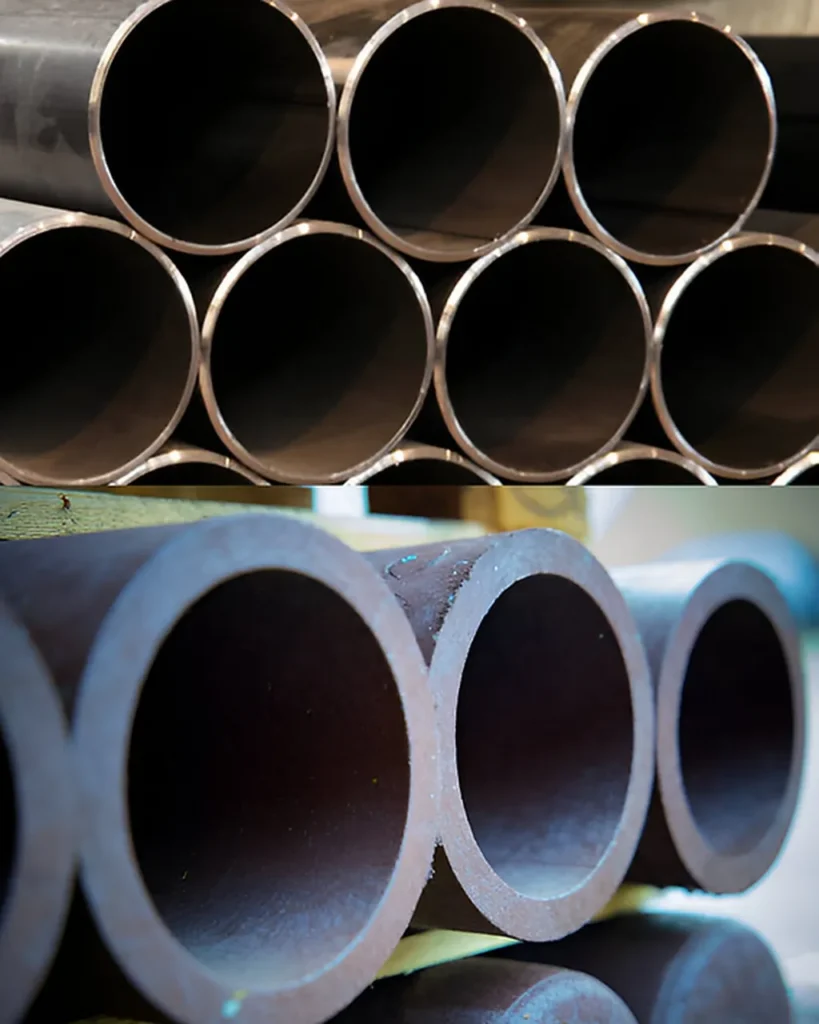
In the pursuit of enhancing the performance and reliability of thick-wall casing steel pipes, particularly those used in challenging environments like oil and gas extraction, researchers have uncovered critical insights into the tempering process. A recent study published in *Teshugang* (which translates to “Iron and Steel” in English) sheds light on how different tempering temperatures and holding times affect the microstructure and hardness of these essential components. The lead author, Wang Zheng, whose affiliation remains undisclosed, delves into the nuances of this process, offering valuable guidance for manufacturers and engineers in the energy sector.
The study focuses on thick-wall sulfur-resistant casing steel pipes, which exhibit a unique microstructure after quenching: martensite (M) at the outer wall and a combination of martensite and bainite (M+B) at the middle wall. The research reveals that within the tempering temperature range of 695°C to 720°C, the Rockwell hardness fluctuation caused by these microstructure differences is minimal, ranging from 0.8 to 1 HRC. However, the real intrigue lies in the temporal aspect of the process.
As the tempering holding time increases, both types of microstructure show a decreasing trend in Rockwell hardness. But here’s the twist: when the tempering holding time falls between 75 to 85 minutes, both microstructures exhibit a notable secondary hardening phenomenon. This finding is crucial for manufacturers aiming to optimize the mechanical properties of their products.
Wang Zheng explains, “The solid solution carbon content of the martensite structure is high, which leads to a relatively fast hardness attenuation during tempering, resulting in poor tempering stability.” However, this higher carbon content also increases the percentage of vanadium carbide (VC) microalloyed precipitates, which in turn compensates for the hardness degradation caused by carbon dissolution. This delicate balance between hardness loss and secondary hardening presents a significant opportunity for manufacturers to fine-tune their processes.
The study underscores the importance of achieving a uniform microstructure to minimize hardness variation across the pipe’s wall thickness. Moreover, it advises that tempering treatment should avoid the secondary hardening interval to ensure the hardness value meets the mechanical property requirements of sulfur-resistant pipes.
The implications of this research are far-reaching for the energy sector. By understanding and controlling the tempering process, manufacturers can produce more reliable and durable casing pipes, which are critical for the safe and efficient extraction of oil and gas. This not only enhances operational safety but also reduces maintenance costs and downtime, ultimately boosting productivity and profitability.
As the energy sector continues to push the boundaries of exploration and extraction, the insights from this study will undoubtedly shape future developments in the field. By leveraging these findings, manufacturers can optimize their production processes, ensuring the delivery of high-quality casing pipes that meet the demanding requirements of modern energy operations.
In the words of Wang Zheng, “This research provides a roadmap for achieving optimal tempering conditions, ultimately leading to improved performance and reliability of thick-wall casing steel pipes.” As the industry continues to evolve, such advancements will be pivotal in driving progress and innovation.