
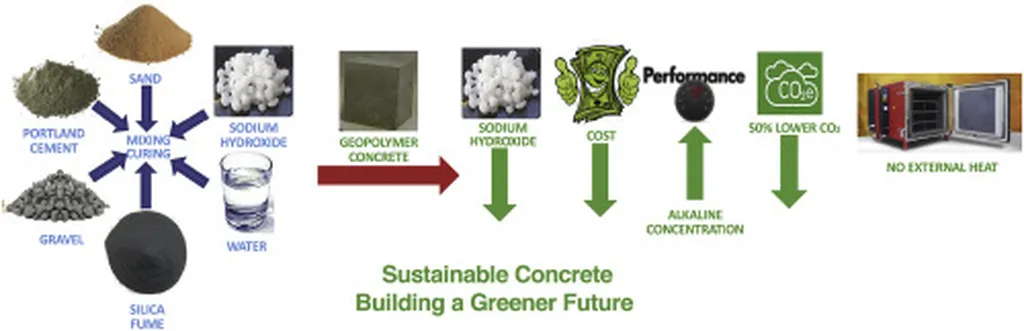
In the quest for sustainable construction materials, researchers have long been exploring alternatives to traditional Portland cement, a significant contributor to global CO2 emissions. A recent study published in the journal *Discover Materials* (which translates to *Discover Materials* in English) offers promising insights into the potential of geopolymer concrete (GPC) as a greener alternative. The research, led by R. Vijaya Sarathy from the Department of Civil Engineering at Atria Institute of Technology, delves into the compressive strength of GPC, particularly when enhanced with ultrafine ground granulated blast furnace slag (UFGGBFS) and crushed stone sand (CSS).
Geopolymer cement (GC) is produced by reacting aluminosilicate by-products with an alkali activator, such as fly ash. This process significantly reduces CO2 emissions compared to the production of ordinary Portland cement (OPC). Sarathy’s study investigates the compressive strength of GPC with varying concentrations of sodium hydroxide (NaOH), ranging from 5 to 8 mol. The findings reveal that increasing NaOH concentration and incorporating UFGGBFS with CSS notably improve the compressive strength of GPC samples.
The study highlights that GPC containing 10% UFGGBFS with an 8 molar NaOH concentration exhibited the highest compressive strength, achieving impressive results of 35.7 MPa, 47 MPa, and 60.2 MPa at curing ages of 7, 28, and 90 days, respectively. “The addition of UFGGBFS not only enhances the strength but also contributes to the sustainability of the construction material,” Sarathy explains. This research underscores the potential of GPC as a viable alternative to traditional concrete, offering both environmental and structural benefits.
Beyond the experimental findings, the study introduces an Artificial Neural Network (ANN) model based on a numerical analysis of literature data. This model predicts the compressive strength of GPC samples, providing a valuable tool for future research and practical applications. “The ANN model offers a robust framework for predicting the performance of GPC, which can be instrumental in optimizing its use in various construction projects,” Sarathy adds.
The implications of this research are far-reaching, particularly for the energy sector, where sustainable construction practices are increasingly prioritized. As the demand for greener building materials grows, the development of high-strength, low-CO2 geopolymer concrete could revolutionize the industry. The study’s findings not only contribute to the scientific understanding of GPC but also pave the way for innovative applications in construction and infrastructure development.
In summary, Sarathy’s research represents a significant step forward in the quest for sustainable construction materials. By leveraging the strengths of UFGGBFS and CSS, and harnessing the predictive power of ANN models, the study offers a compelling vision for the future of geopolymer concrete. As the construction industry continues to evolve, the insights gained from this research will undoubtedly shape the development of greener, more resilient building materials.