
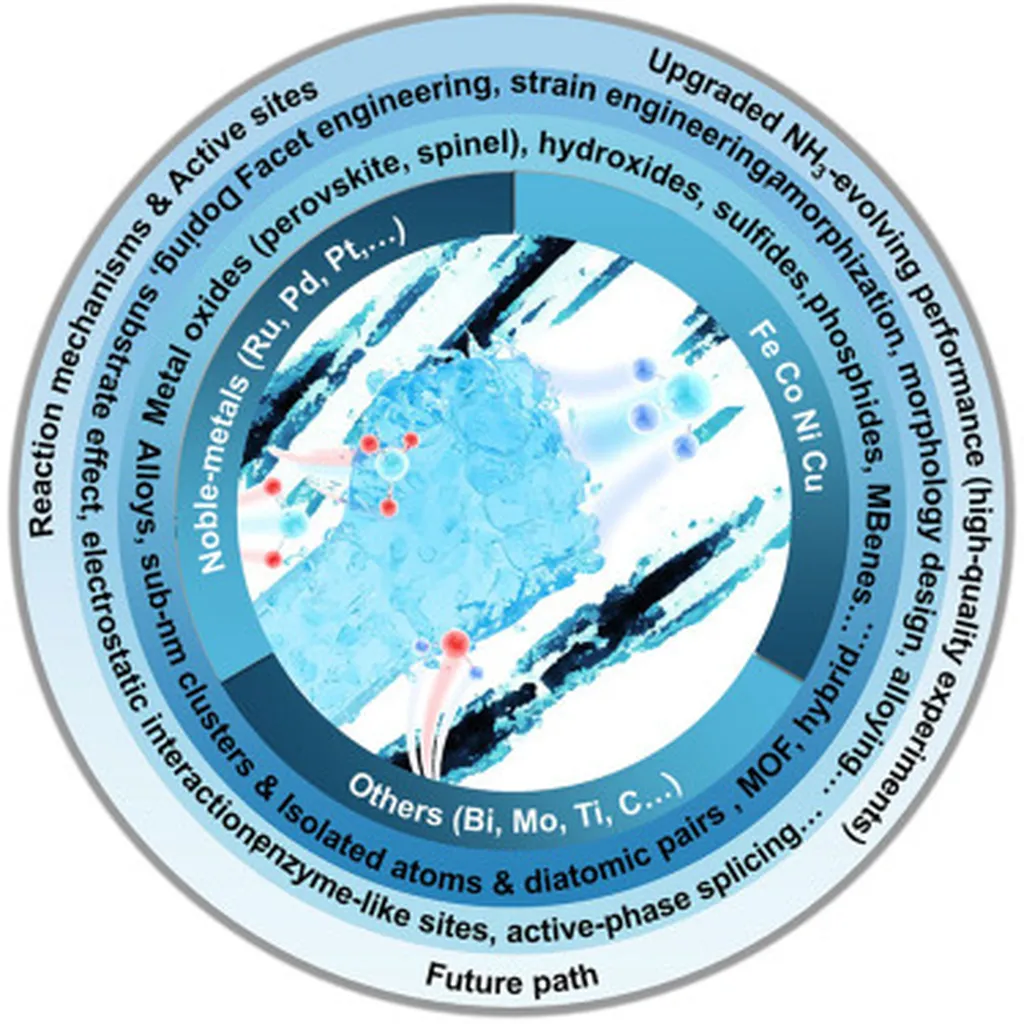
In the quest for sustainable nitrogen management, a team of researchers led by Yuecheng Xiong from the Department of Chemistry at City University of Hong Kong has made significant strides. Their work, published in the journal SmartMat (translated as “Intelligent Materials”), focuses on coupling the electrochemical nitrate reduction reaction (NO3RR) with ammonia (NH3) recovery, a process that could revolutionize decentralized nitrogen management and have substantial commercial impacts on the energy sector.
Nitrate pollution in water bodies is a growing concern, and converting it into ammonia through NO3RR presents an attractive solution. However, the challenge lies in the direct reuse of ammonia dissolved in the post-reaction solution. “NH3 dissolved in the post‐reaction solution is limited for direct reuse toward downstream purposes, thereby undermining the application potentials and economic viability of NO3RR,” explains Xiong. The team’s research highlights that instantaneous NH3 recovery after NO3− conversion reduces the entropy of the system, thermodynamically favoring the forward reaction.
The integration of NH3 recovery with NO3RR is not just about resource recovery but also about environmental safety, considering ammonia’s toxicity. This coupled process presents a promising solution for decentralized nitrogen management, particularly in areas with limited access to the power grid and commercial fertilizers. The research introduces principles and engineering design of NH3 recovery, with a highlight on heat as a suitable driving force.
The implications for the energy sector are significant. Enhanced reactant and product selectivity through smart materials design could facilitate the treatment of different nitrogen sources. Moreover, incorporating current energy infrastructures could lead to enhanced access to electricity, sanitation, and fertilizers. As Xiong notes, “Enhancing the reactant and product selectivity by smart materials design will facilitate the treatment of different nitrogen sources, and incorporating current energy infrastructures leads a way of enhancing access to electricity, sanitation and fertilizers.”
This research could shape future developments in the field by providing a more efficient and sustainable approach to nitrogen management. The coupling of NO3RR with NH3 recovery could pave the way for decentralized systems that are not only environmentally friendly but also economically viable. As the world grapples with the challenges of nitrogen pollution and the need for sustainable agriculture, this research offers a glimmer of hope and a promising direction for future innovations.