
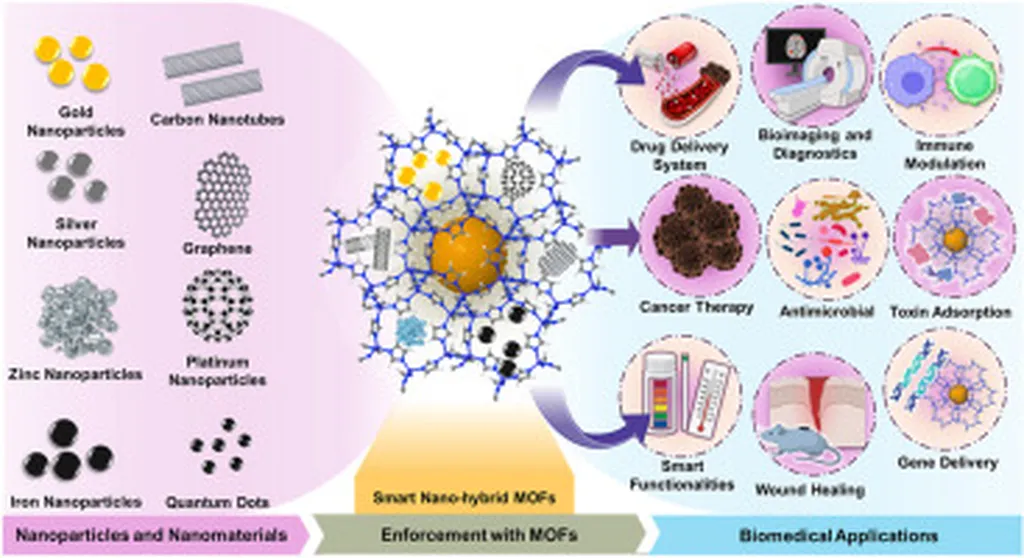
In the ever-evolving landscape of biomedical research, a groundbreaking study published in *SmartMat* (translated from Chinese as “Intelligent Materials”) is making waves. The research, led by Xiaoyan Lu from the College of Chemistry and Chemical Engineering at Luoyang Normal University in China, explores the potential of metal-organic framework (MOF)-based nanomaterials in revolutionizing cancer therapy, antimicrobial treatments, and anti-inflammatory therapies.
MOFs are a class of highly porous materials composed of metal ions and organic ligands. Their unique structure offers a high surface area and tunable porosity, making them ideal candidates for a variety of applications. Lu and her team have categorized these nanomaterials into three key classes: intrinsic theranostic MOFs, carrier-type MOFs, and hybrid theranostic composites.
Intrinsic theranostic MOFs utilize their metal nodes or organic ligands for inherent therapeutic or diagnostic functions. “These MOFs can act as both a therapeutic agent and a diagnostic tool,” Lu explains. “This dual functionality makes them highly efficient and versatile.”
Carrier-type MOFs, on the other hand, are designed for high-capacity drug delivery with stimuli-responsive release. This means they can deliver drugs directly to the site of infection or tumor, reducing side effects and improving treatment efficacy.
Hybrid theranostic composites integrate MOFs with functional components for multimodal imaging and synergistic therapies. “This approach allows us to combine different therapeutic strategies and imaging techniques, providing a more comprehensive treatment and monitoring solution,” Lu adds.
The potential commercial impacts of this research are significant. In the energy sector, MOFs have already shown promise in gas storage and separation. The biomedical applications explored in this study could open up new avenues for collaboration between the energy and healthcare industries.
However, the path to clinical translation is not without challenges. Biosafety, scalability, and targeting efficiency are key areas that need to be addressed. Lu emphasizes the need for biodegradable designs, green synthesis, and multifunctional platforms. “Interdisciplinary collaboration is essential to bridge the gap between innovation and clinical implementation,” she says.
As we look to the future, the research published in *SmartMat* offers a glimpse into the potential of MOF-based nanomaterials in precision medicine. The study not only advances our understanding of these materials but also paves the way for innovative solutions in healthcare. The energy sector, too, stands to benefit from these developments, as the boundaries between industries continue to blur.
In a world where technology and science are advancing at an unprecedented pace, this research serves as a reminder of the power of interdisciplinary collaboration and the potential of nanomaterials to transform our lives.