
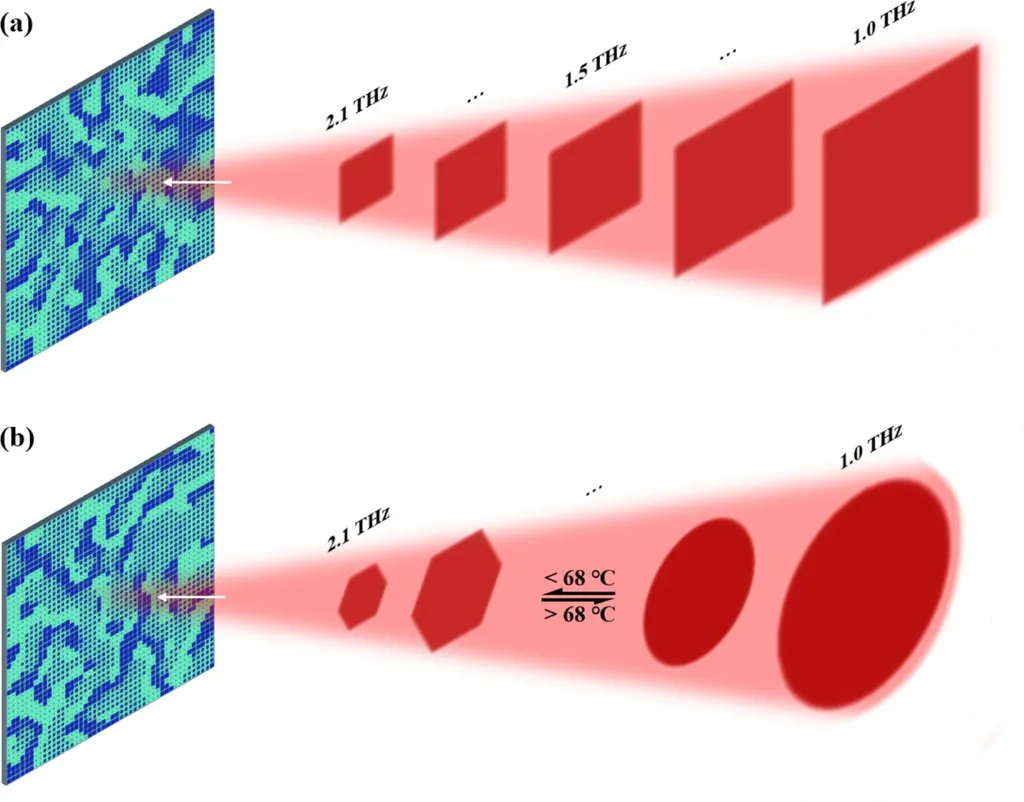
In a groundbreaking development poised to revolutionize data security and wireless communication, researchers have unveiled a novel approach to terahertz (THz) holographic image encryption. The study, led by Lingyun Zhu from the School of Information Science and Technology at ShanghaiTech University, introduces a thermally tunable directional Janus metasurface that promises to enhance data storage, encryption, and secure communication.
The research, published in *SmartMat* (translated as *Smart Materials*), addresses the limitations of conventional forward design methods in THz holography. These methods typically offer only two degrees of freedom (DOFs), restricting the number of channels and the quality of holographic imaging. Zhu and his team have developed a bidirectional deep neural network (Bi-DNN) inverse design method, combined with vanadium dioxide (VO2), a thermally responsive phase-change material. This innovation enables independent control of incident direction, frequency, and temperature as three distinct DOFs.
“The meta-atoms selected through the Bi-DNN exhibit a transmittance exceeding 90%, effectively generating low-crosstalk, eight-channel THz holographic images with an imaging efficiency of 78%,” Zhu explained. This breakthrough allows for high-intensity and high-density holographic encryption in the THz band, leveraging the superposition properties of Chinese characters.
The implications for the energy sector are profound. Secure wireless communication is crucial for the transmission of sensitive data, and this technology could provide an additional layer of security. “This design offers a novel strategy and technical foundation for applications in high-capacity data storage, holographic encryption, and secure wireless communication,” Zhu noted.
The integration of Janus metasurfaces with THz holography opens new avenues for biomedical detection, virtual reality, and information encryption security. The ability to independently control the amplitude and phase of THz waves from opposite directions offers a promising platform for directional multiplexing, enhancing the versatility and efficiency of THz systems.
As the world continues to grapple with the challenges of data security and the need for robust communication networks, this research provides a glimpse into the future of secure data transmission. The development of thermally tunable directional Janus metasurfaces represents a significant step forward, offering a technical foundation that could shape the next generation of secure communication technologies.
In the rapidly evolving landscape of data security and wireless communication, this research stands out as a beacon of innovation. The work published in *SmartMat* not only advances our understanding of metasurfaces and THz holography but also paves the way for practical applications that could transform the energy sector and beyond.