
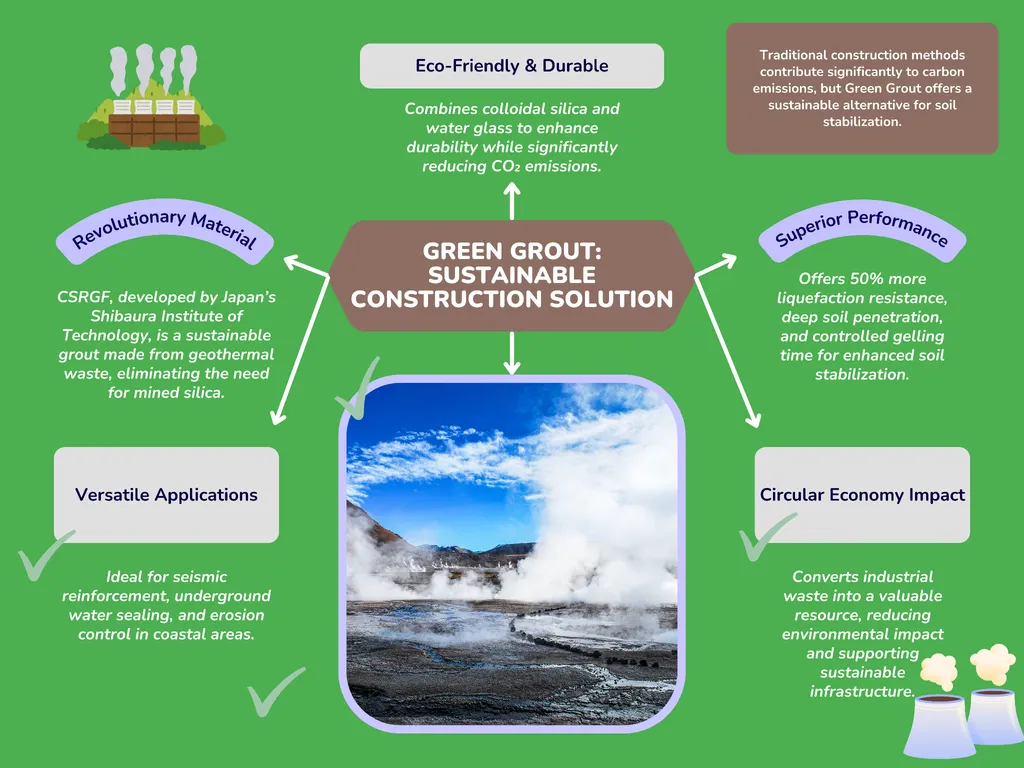
In the quest for sustainable construction materials, researchers have made a significant stride by integrating recycled waste materials into cementitious grouts, potentially revolutionizing underground reinforcement and structural repair in the energy sector. A recent study led by Alireza Entezam from the Centre for Future Materials (CFM) at the University of Southern Queensland explores the mechanical integrity and rheological behavior of these innovative grout formulations, offering a promising alternative to traditional Portland cement-based grouts.
The research, published in *Discover Materials* (which translates to *Discover Materials* in English), focuses on partially replacing cement with recycled waste glass (WG), tyre rubber waste (TRW), and construction and demolition waste (CDW). This approach addresses the environmental impact of Portland cement, which accounts for nearly 7% of global CO₂ emissions and significant resource depletion.
Entezam and his team evaluated grout mixtures incorporating varying percentages of these waste materials. The results were promising: all modified grouts maintained shear-thinning properties but exhibited significantly reduced viscosity, enabling lower water demand. Notably, grouts enhanced with waste glass preserved or even improved unconfined compressive strength (UCS). “For example, 2.5–5% WG substitution resulted in minimal strength loss, yielding up to 97% of the 70.5 MPa control strength,” Entezam explained. “When adjusted for reduced water content, these mixes achieved a 10.6% UCS increase.”
Tyre rubber waste grouts peaked at 55.2 MPa with 0.75% inclusion, while construction and demolition waste caused only minor strength drops at 2.5–5%. Enhanced flowability compensated for some strength reductions, making these grouts viable for practical applications.
Microstructural analysis revealed that waste glass improved matrix density via pozzolanic activity and filler effect, while tyre rubber waste and construction and demolition waste influenced pore structure. These findings underscore the practical potential of recycled waste-based grouts to reduce cement consumption, lower embodied carbon, and divert waste streams from landfills.
The implications for the energy sector are substantial. Sustainable grouts can be used for ground reinforcement, structural repair, and other applications, offering viable alternatives that meet both engineering and environmental demands. As the industry seeks to reduce its carbon footprint, these innovations could play a crucial role in shaping future developments.
Entezam’s research highlights the importance of integrating recycled materials into construction practices. “Beyond their laboratory performance, these findings demonstrate a promising pathway toward lower-impact cementitious grouts,” he said. This work not only advances the field of sustainable construction but also sets a precedent for future research and commercial applications.
As the energy sector continues to evolve, the adoption of these sustainable grouts could significantly impact ground support and structural integrity, paving the way for a more environmentally conscious industry. The study published in *Discover Materials* serves as a testament to the potential of recycled waste materials in creating durable, efficient, and eco-friendly construction solutions.