
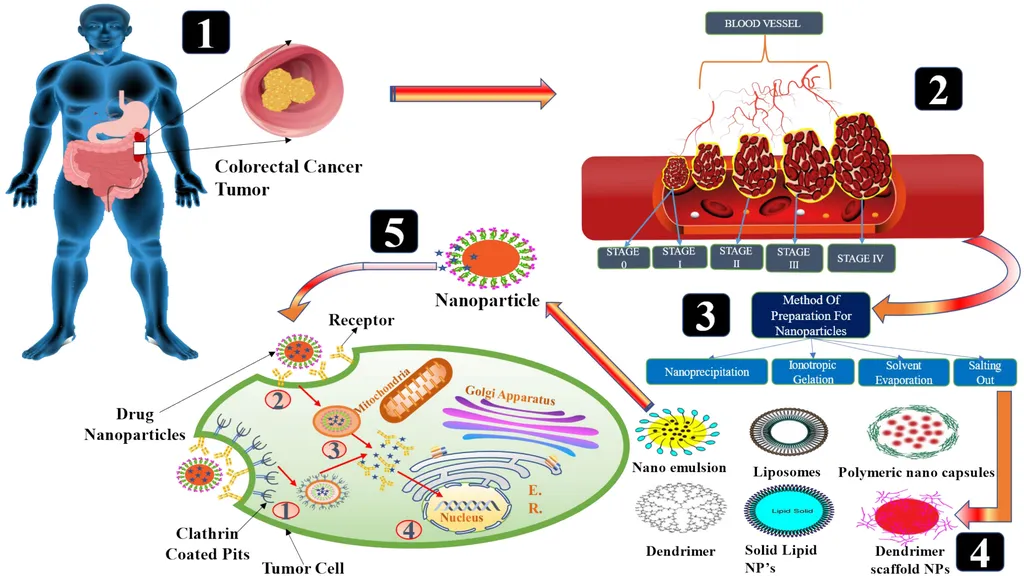
In the relentless battle against colorectal cancer, a team of researchers led by Dolma Choezom at the University Medical Center Göttingen (UMG) in Germany has made a significant stride. Their work, published in the journal *Small Science* (which translates to *Small Science* in English), introduces a novel approach to chemotherapeutic drug delivery that could potentially reshape the landscape of cancer treatment. The study focuses on a unique drug-cocktail core@shell nanocarrier system designed to deliver a combination of irinotecan (ITC) and 5-fluorouracil (5-FU) metabolite (FdUMP), a common duo in colorectal cancer chemotherapy regimens.
The challenge with conventional chemotherapy is multifaceted: poor tumor targeting, severe side effects, and high drug resistance. Choezom and her team aimed to address these issues by developing nanocarriers with an impressive drug loading capacity of 57% by mass, one of the highest reported for a chemotherapeutic drug cocktail. “This high drug payload is a game-changer,” Choezom explains. “It allows us to deliver a substantial amount of the therapeutic agents directly to the tumor site, minimizing the toxic side effects often seen with systemic chemotherapy.”
The innovation doesn’t stop at high drug loading. The researchers employed a probe-based imaging strategy with mechanistically responsive fluorescent reporters to track the nanocarriers’ journey within the cells. They discovered that the nanocarriers are taken up by the cells predominantly through macropinocytosis, a process by which cells ingest extracellular fluid and its contents. Once inside, the nanocarriers rapidly traffic to endolysosomal compartments, where the acidic environment triggers sustained drug release.
“This slow uptake and subsequent trafficking behavior lead to a delayed yet prolonged cytotoxic effect in colorectal cancer cells,” Choezom notes. “It’s a more controlled and sustained release mechanism, which we believe can enhance the efficacy of the treatment while reducing the likelihood of drug resistance.”
The study provides the first direct evidence linking slow uptake, intracellular trafficking, and progressive nuclear delivery of nanocarrier cargo to the delayed yet sustained cytotoxic response. This finding not only highlights the therapeutic potential of these nanocarriers but also underscores the broad applicability of the probe-based imaging approach to elucidate the mechanistic intracellular trafficking and nuclear delivery of various types of nanoparticles.
The implications of this research extend beyond colorectal cancer. The probe-based imaging strategy could be applied to study the intracellular behavior of other nanoparticles, paving the way for more effective and targeted drug delivery systems across different medical fields. As Choezom and her team continue to refine their approach, the potential for commercial impact in the energy sector, particularly in targeted drug delivery and nanotechnology, becomes increasingly apparent.
In the words of Choezom, “This is just the beginning. The insights gained from this study could revolutionize how we approach cancer treatment and potentially other diseases, making therapies more effective and less burdensome for patients.” With the publication of this groundbreaking research in *Small Science*, the scientific community is one step closer to realizing this vision.