
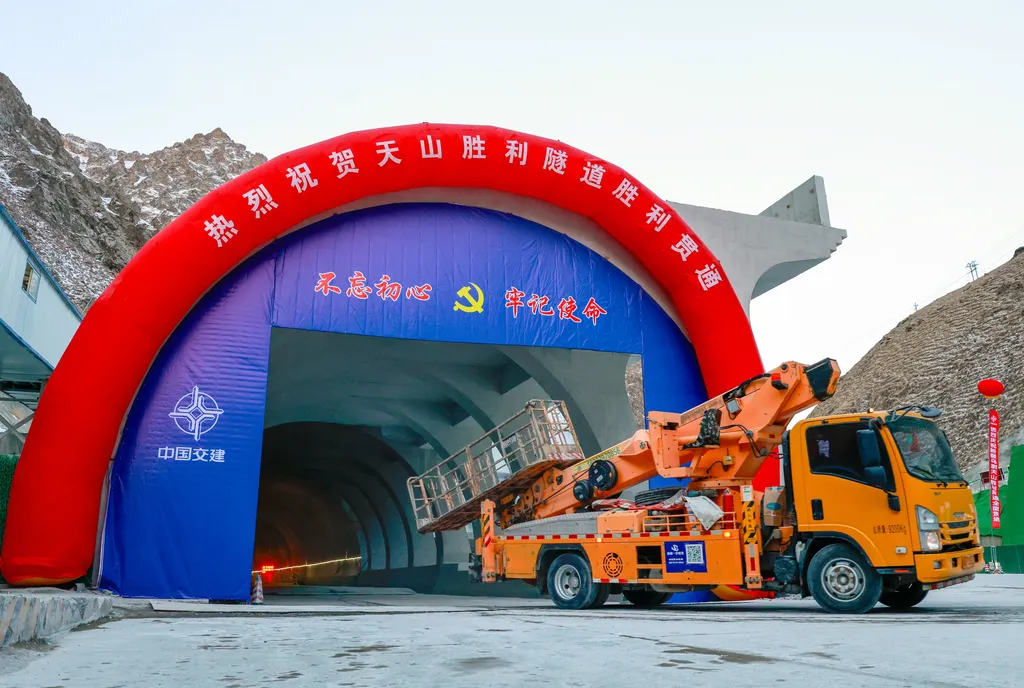
In the heart of Southwest China, a deep diversion tunnel project has become a real-world laboratory for understanding how seismic activity can impact tunnel construction. A recent study, led by Bin Gan of the Guangxi Water and Power Design Institute Co., Ltd., and published in *Advances in Civil Engineering* (which translates to *Advances in Civil Engineering*), sheds light on the mechanical responses and collapse processes of tunnels under seismic loading during construction. The findings could have significant implications for the energy sector, particularly in earthquake-prone regions where such tunnels are crucial for hydroelectric projects and other infrastructure.
The study employed a coupled continuum-discrete numerical simulation method to investigate the collapse mechanisms of diversion tunnels. Before any seismic activity, the initial support system was found to be generally stable, with minor damage observed at the arch foot and arch crown. However, under seismic loading, the support structure experienced significant stress redistribution, with the maximum principal stress reaching an alarming 67.7 MPa.
“Seismic loading causes a dramatic redistribution of stress within the tunnel support system,” explained Gan. “This can lead to a chain reaction of failures, starting at the arch foot and propagating towards the arch crown, ultimately resulting in a through-going crack and the collapse of the upper tunnel section.”
The numerical simulations conducted by Gan and his team showed a striking agreement with actual field results in terms of spatial distribution and damage characteristics. This alignment between simulation and reality is a testament to the robustness of the methods used and provides a solid foundation for future research and practical applications.
For the energy sector, particularly in regions prone to seismic activity, these findings are invaluable. Diversion tunnels are critical components of hydroelectric projects, and understanding their behavior under seismic loading can inform better design and safety evaluations. “Our findings provide practical guidance for dynamic safety evaluation and the design of seismic-resistant tunnel support systems,” Gan noted. “This is crucial for ensuring the safety and longevity of infrastructure in earthquake-prone areas.”
The study’s insights could lead to more resilient tunnel designs, reducing the risk of catastrophic failures and the associated economic losses. As the energy sector continues to expand into regions with significant seismic activity, the ability to predict and mitigate the impacts of earthquakes on tunnel construction will be paramount.
In summary, Gan’s research offers a compelling case study that highlights the importance of understanding the mechanical responses of tunnels under seismic loading. By providing a clearer picture of the collapse processes, this study paves the way for more robust and safer tunnel designs, ultimately benefiting the energy sector and other industries reliant on underground infrastructure.