
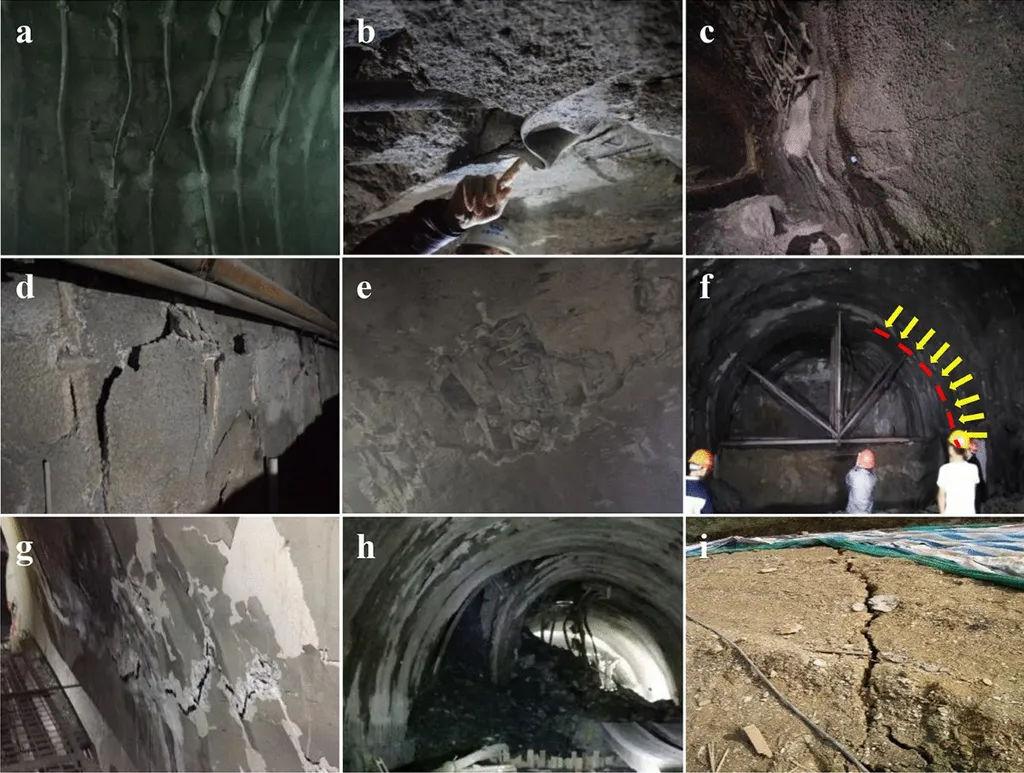
In the heart of China’s Henan Province, a critical water conveyance tunnel project faced a formidable challenge: the instability of water-bearing argillaceous soft rock, a material notorious for its high porosity and low bearing capacity. This type of rock, when exposed to water and stress, can deform and fail over time, a phenomenon known as creep-seepage interaction. The consequences? Construction delays, safety risks, and significant financial losses. Enter Xuejiu Wang, a researcher from the Henan Vocational College of Water Conservancy and Environment, who has been tackling this issue head-on.
Wang and his team delved into the intricate world of multifield coupling mechanisms, investigating how different pressures and time affect the creep characteristics and permeability evolution of this troublesome rock. Their findings, published in the *Advances in Civil Engineering* (which translates to *Advances in Civil Engineering* in English), are nothing short of groundbreaking. They discovered that a mere 0.1 MPa increase in confining pressure could boost the peak strength of the rock by 12.09% and slash creep deformation by a staggering 88.06%. “This is a significant improvement in stability,” Wang noted, “and it’s achieved with a relatively small increase in pressure.”
But the team didn’t stop there. They also found that permeability decreases nonlinearly with increasing axial pressure. “Under a confining pressure of 0.1 MPa, the permeability decreased by 1.28×10⁻¹⁵ m² when the axial pressure increased to 0.4 MPa,” Wang explained. High confining pressure, they observed, significantly diminishes the effect of axial pressure on permeability, reducing its influence to just 28.9% of that under low confining pressure.
So, what does this mean for the energy sector and other industries relying on stable tunnel construction? A lot. By understanding and controlling these multifield coupling mechanisms, engineers can design more effective support systems, ensuring the safety and longevity of tunnels in challenging geological conditions. Wang’s team proposed a composite support system of “inverted steel arch + rock bolts + shotcrete,” which has proven effective in controlling surrounding rock deformation.
The implications of this research are far-reaching. As Wang puts it, “This study provides theoretical and technical support for stability control in water-bearing argillaceous soft rock tunnels.” With this newfound knowledge, the energy sector can look forward to more efficient, safer, and cost-effective tunnel construction projects. The future of tunnel engineering, it seems, is looking a lot more stable.