
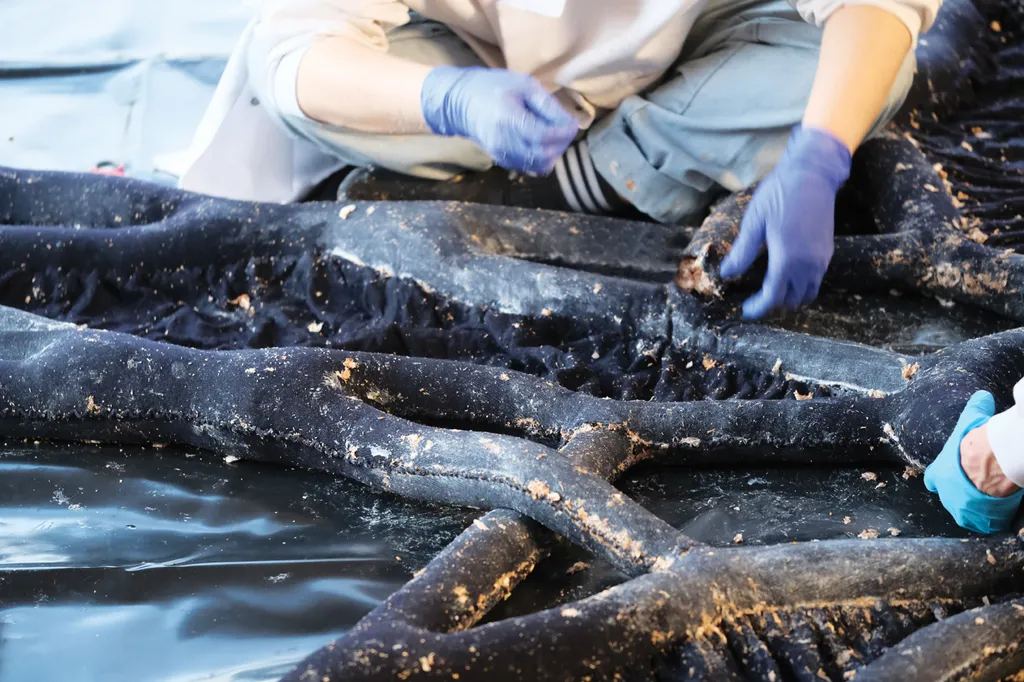
In a groundbreaking study published in the journal *Cleaner Materials* (translated as “Cleaner Materials”), researchers have unveiled a novel approach to transforming textile waste into high-performance biocomposites using mycelium, the vegetative part of fungi. This innovative research, led by Sarath Haridas Kaniyamparambil from the Department of Chemical & Petroleum Engineering at Khalifa University of Science & Technology in Abu Dhabi, opens up new avenues for sustainable materials in various industries, including construction and energy.
The study focuses on the biofabrication of mycelium-fabric biocomposites, utilizing shredded textile fabrics such as cotton, polyester, and mixed shredded textile fabrics (MSTF). The results are promising, demonstrating that mycelium can effectively bind these textiles to form bio-blocks with distinct colonization patterns depending on the type of fabric and inoculation conditions.
“Our findings establish mycelium as an effective binding agent for textiles towards the formation of materials with complex forms benefiting from the inherent attributes of textiles,” said Kaniyamparambil. This breakthrough could revolutionize the way we think about waste management and material science, particularly in the energy sector where sustainable and efficient materials are in high demand.
The biocomposites exhibited impressive mechanical properties. Cotton-based composites showed a flexural strength of 82.5 kPa and a toughness of 3298 kJ/m³, while polyester-based composites had a similar flexural strength of 80.5 kPa but with half the toughness at 1414 kJ/m³. These properties make them suitable for a range of applications, from insulation materials to structural components.
Flammability tests revealed that cotton-based composites extinguished flames after 30 seconds, with 40% of the area burned. In contrast, polyester-based composites reduced the combustion rate by 76%, highlighting their potential as flame-retardant materials. This is particularly significant for the energy sector, where safety and fire resistance are critical considerations.
A comprehensive life cycle assessment (LCA) conducted as part of the study showed that the climate change potential of these biobricks varies significantly based on the energy mix scenario. Using renewable-based energy, the potential is as low as 0.05 kg-CO2-equiv per kilogram of biobrick, compared to 4.28 kg-CO2-equiv per kilogram when using a fossil-based energy mix. This underscores the importance of sustainable energy practices in minimizing the environmental impact of material production.
The research not only addresses the pressing issue of textile waste but also paves the way for the development of sustainable, high-performance materials. As the world increasingly turns to renewable and eco-friendly solutions, this study offers a glimpse into the future of biofabrication and its potential to transform industries.
“This research is a significant step forward in the quest for sustainable materials,” said Kaniyamparambil. “It showcases the potential of mycelium as a versatile and environmentally friendly binding agent, offering a viable solution to the challenges posed by textile waste and the need for sustainable materials in various industries.”
As the energy sector continues to evolve, the integration of such innovative materials could play a pivotal role in achieving sustainability goals. The study published in *Cleaner Materials* not only highlights the technical feasibility of mycelium-fabric biocomposites but also underscores the importance of interdisciplinary research in driving forward the frontiers of material science and environmental sustainability.