
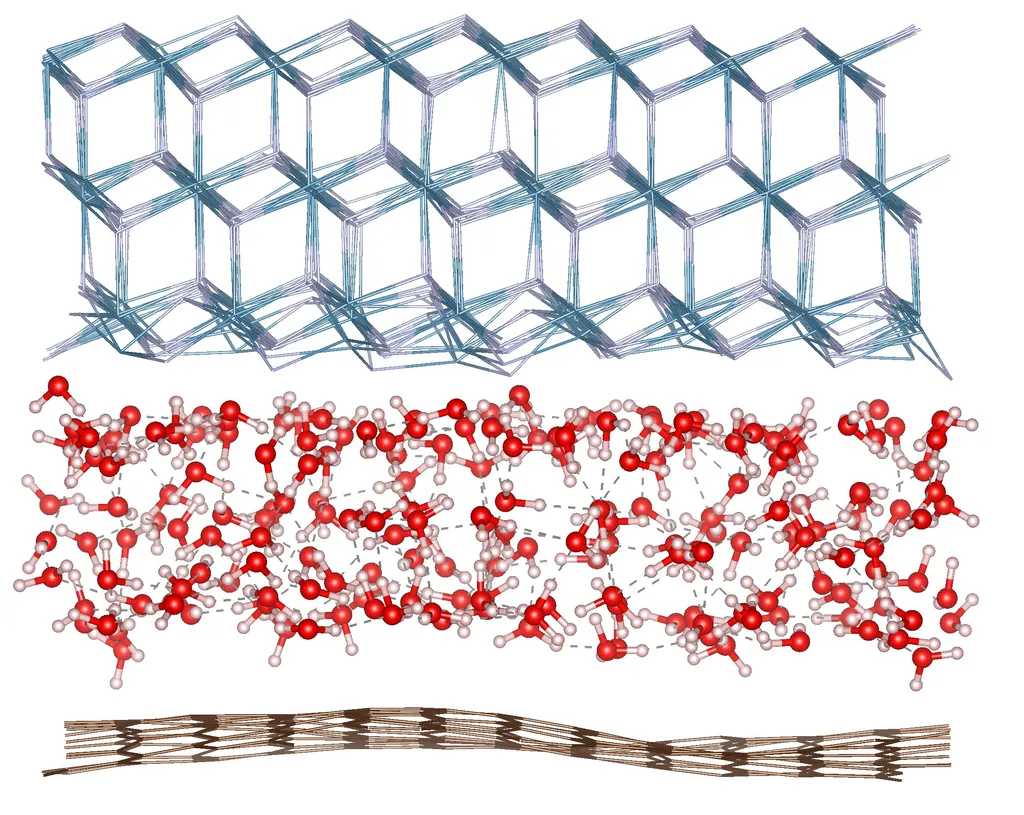
In the heart of Germany, at the Max-Planck-Institut für Kohlenforschung (Max Planck Institute for Coal Research), a team of scientists led by Abdurrahman Bilican has been delving into the intricate world of sol-gel-derived nanoporous polymers. Their recent study, published in the journal ‘Small Science’ (translated from German as ‘Small Science’), is shedding new light on how these materials form and how their properties can be fine-tuned for various applications, particularly in the energy sector.
The research focuses on resorcinol-formaldehyde gels, a type of polymer gel that has garnered significant interest due to its nanoporous structure. These materials are not just scientifically intriguing; they hold promise for energy storage, catalysis, and insulation. The team’s comprehensive investigation reveals the delicate dance between synthesis parameters, structure, and porous properties that dictate the final material’s performance.
The scientists employed a suite of advanced techniques to monitor the gel formation process in real-time. In situ small-angle X-ray scattering and nuclear magnetic resonance (NMR) spectroscopy allowed them to observe the transition from a liquid solution to a solid gel. They discovered that the formation of primary particles and nanopores is a rapid process, completing within minutes, depending on the temperature. “The kinetics of these processes are temperature-dependent,” explains Bilican. “At 120°C, the reaction is completed within 12 minutes, while at 80°C, it takes about 60 minutes.”
The study also uncovered that extending the reaction time beyond these points enhances the cross-linking of the polymer. This increased cross-linking stabilizes the pores and reduces shrinkage during the drying process, resulting in xerogels (dried gels) with larger pore volumes, larger external surface areas, and larger average pore sizes. “Extended reaction time, i.e., higher degree of polymer cross-linking, enhances pore stability and reduces gel shrinkage during drying,” Bilican notes.
The implications of this research are significant for the energy sector. Nanoporous polymers are crucial for energy storage devices like supercapacitors and batteries, where their high surface area and tunable pore size can enhance performance. Moreover, these materials can be used in catalysis, where their porous structure provides ample space for catalytic reactions to occur. In insulation applications, their nanoporous structure can effectively trap heat, reducing energy loss.
The study provides a rational tool for tuning aerogel/xerogel performance through synthesis design. This means that scientists and engineers can now more precisely control the properties of these materials, tailoring them for specific applications. As Bilican puts it, “This work rationalizes molecular-scale transformation of polymers with macroscopic properties, thus providing a rational tool for tuning aerogel/xerogel performance through synthesis design.”
The research published in ‘Small Science’ is a testament to the power of fundamental science in driving technological advancements. By understanding the intricate details of how these materials form, we can pave the way for more efficient, high-performance materials that will shape the future of the energy sector. The study not only advances our scientific understanding but also opens up new avenues for innovation and application.