
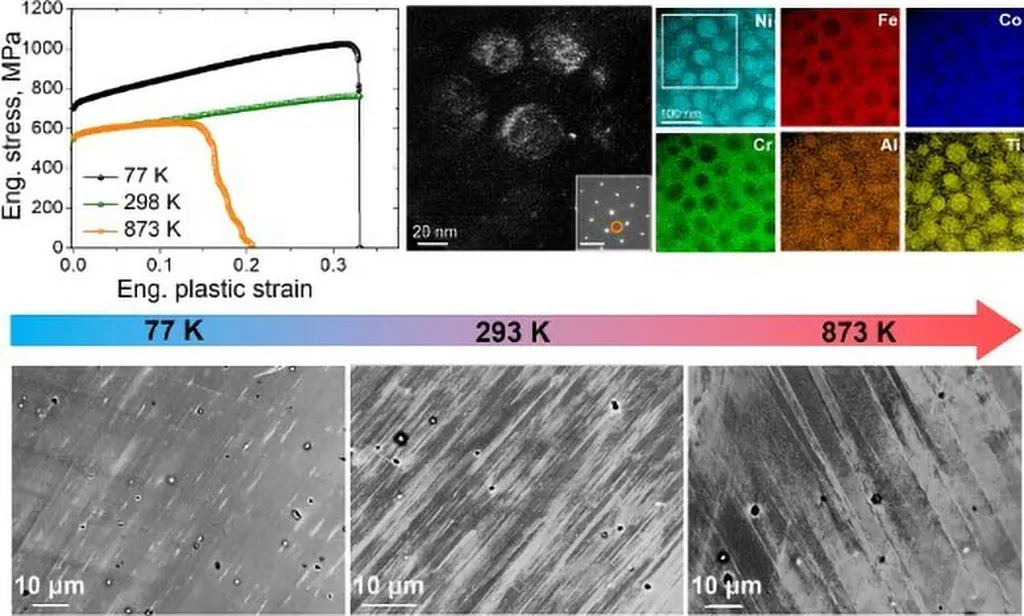
In the quest to bolster the mechanical properties of advanced materials, researchers have long explored the potential of heterostructured materials, which combine different microstructural features to enhance performance. A recent study published in *Materials Research Letters* (translated from Korean as “Materials Research Letters”) sheds new light on this approach, focusing on L12-strengthened high-entropy alloys. The research, led by Jae Heung Lee from the Department of Materials Science and Engineering at Pohang University of Science and Technology (POSTECH) in South Korea, reveals that controlling the ratio of continuous-to-discontinuous precipitation (CP-to-DP) can significantly improve the tensile properties of these alloys.
High-entropy alloys, known for their exceptional strength and durability, have garnered considerable attention in industries ranging from aerospace to energy. The study by Lee and his team delves into the intricate world of heterostructuring, where materials are designed with a mix of continuous and discontinuous precipitation regions. The researchers found that by adjusting the CP-to-DP ratio, they could achieve a remarkable balance of strength and ductility.
“By systematically comparing two specimens with different CP-to-DP ratios, we discovered that the specimen with a higher discontinuous precipitation fraction exhibited superior yield strength and strain-hardening capability,” Lee explained. This improvement is attributed to the higher intrinsic hardness and strain-hardenability of the discontinuous precipitation region, as well as the phenomenon known as hetero-deformation-induced strengthening.
The implications of this research are profound, particularly for the energy sector. High-entropy alloys are already being considered for use in extreme environments, such as in nuclear reactors and high-efficiency turbines. The ability to fine-tune the mechanical properties of these alloys through heterostructuring could lead to the development of more robust and efficient energy systems.
“Our findings provide valuable insights into the design of heterostructured materials,” Lee added. “By understanding the role of the CP-to-DP ratio, we can optimize the mechanical performance of high-entropy alloys for a wide range of applications.”
As the energy sector continues to demand materials that can withstand harsh conditions and deliver superior performance, the research by Lee and his team offers a promising avenue for innovation. The study not only advances our understanding of heterostructuring but also paves the way for the development of next-generation materials that could revolutionize the energy landscape.
In a field where every increment in material performance can translate to significant gains in efficiency and safety, this research marks a significant step forward. As industries strive to meet the growing demands for sustainable and reliable energy solutions, the insights gained from this study could play a crucial role in shaping the future of materials science and engineering.