
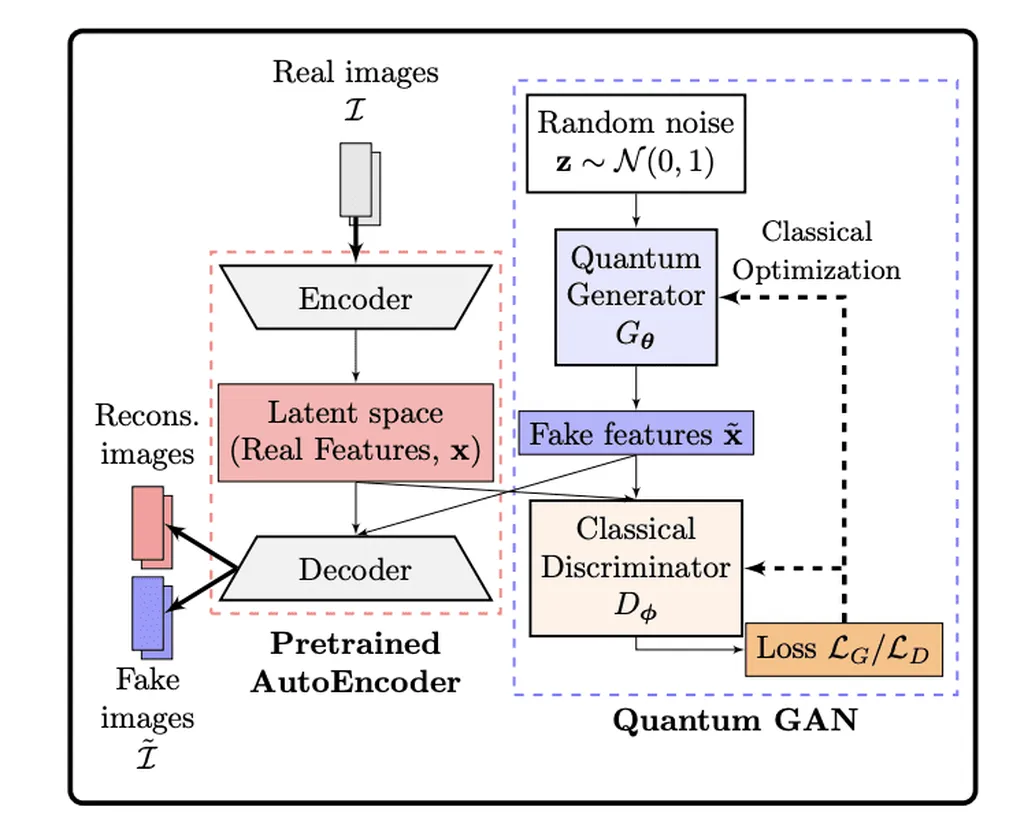
In the ever-evolving landscape of artificial intelligence and quantum computing, a groundbreaking study has emerged that could reshape the way we approach image generation and machine learning. Researchers have developed a novel framework that combines the power of quantum computing with classical generative adversarial networks (GANs), potentially unlocking new efficiencies and capabilities for industries, including the energy sector.
At the heart of this innovation is the dual-discriminator hybrid quantum generative adversarial network (DDHQ-GAN), a sophisticated architecture designed to enhance the performance of conventional GANs. The study, led by Purin Pongpanich from the Department of Computer Engineering at Mahidol University in Thailand, introduces a hybrid quantum discriminator that works in tandem with a classical generator and two discriminators. This unique configuration aims to improve the quality of generated images while maintaining computational efficiency.
The research, published in the IEEE Transactions on Quantum Engineering (translated to English as “IEEE Transactions on Quantum Engineering”), evaluates the efficacy of the DDHQ-GAN using the Fréchet inception distance (FID) as a quantitative metric. The results are promising, with the DDHQ-GAN achieving superior performance compared to existing GAN variants. “The DDHQ-GAN demonstrates a significant improvement in image generation quality, reflected by lower FID scores,” Pongpanich explained. “This advancement is achieved with only a marginal increase in the number of parameters and quantum computational resources.”
The study also delves into the interplay between the structural configurations of parameterized quantum circuits, classical neural network architectures, and model hyperparameters. Using the Modified National Institute of Standards and Technology (MNIST) dataset as the experimental benchmark, the researchers provide a comprehensive analysis of the factors that contribute to the enhanced performance of the DDHQ-GAN.
The implications of this research extend beyond the realm of academia, with potential applications in various industries. In the energy sector, for instance, improved image generation capabilities could enhance data visualization and analysis, leading to more informed decision-making and optimized resource management. “The energy sector is increasingly reliant on data-driven insights to optimize operations and reduce costs,” Pongpanich noted. “Our research could provide a valuable tool for energy companies looking to leverage the power of quantum computing and machine learning.”
As the field of quantum machine learning continues to evolve, the DDHQ-GAN framework offers a glimpse into the future of hybrid quantum-classical systems. By bridging the gap between quantum and classical computing, this research paves the way for new advancements in image generation, machine learning, and beyond. The study not only highlights the potential of quantum computing to revolutionize traditional AI techniques but also underscores the importance of interdisciplinary collaboration in driving innovation.
In the words of Pongpanich, “This research is a testament to the power of collaboration and the potential of quantum computing to transform the way we approach complex problems.” As we stand on the brink of a new era in computing, the DDHQ-GAN framework serves as a beacon of hope for a future where quantum and classical systems work in harmony to unlock new possibilities.