
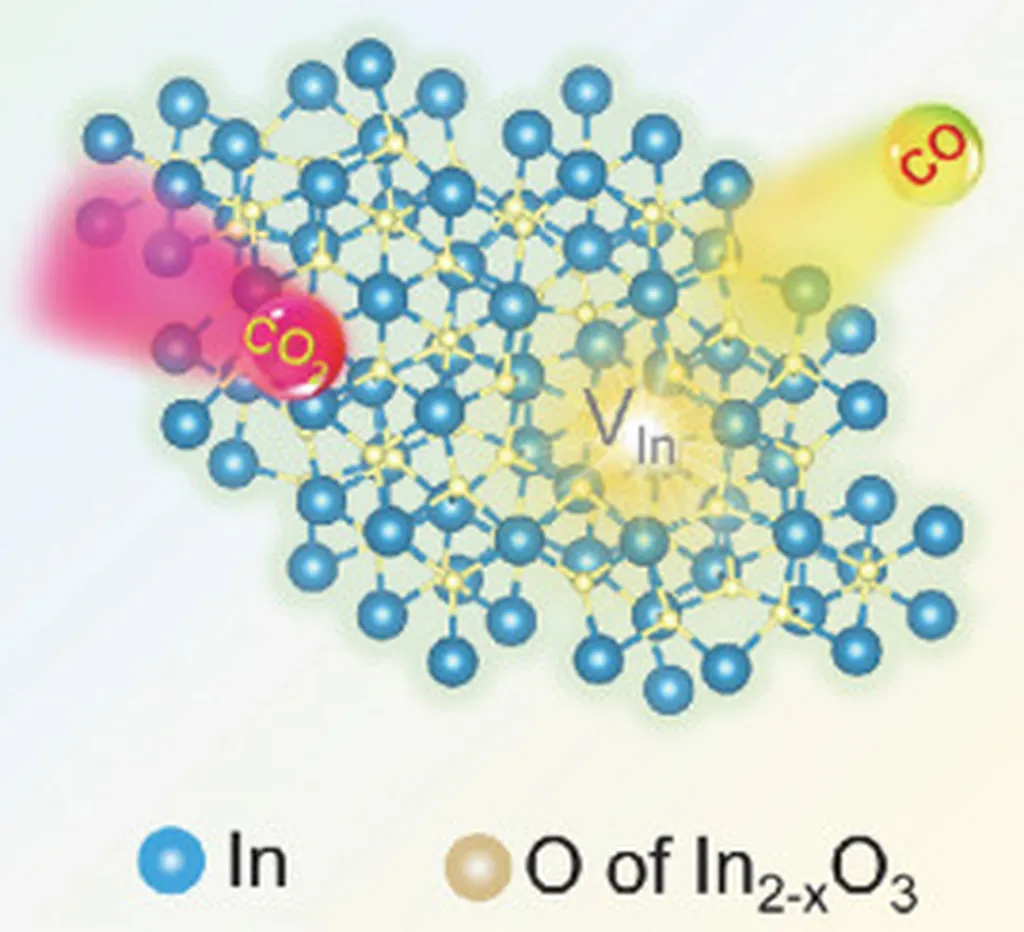
In a significant stride towards enhancing CO2 photoreduction, researchers from the Institute of Environmental Technology at VSB-Technical University of Ostrava have unveiled a novel approach to defect engineering in TiO2-based photocatalysts. Led by Rudolf Ricka, the study, published in Applied Surface Science Advances (a journal that translates to “Advances in Surface Science”), introduces a method that could revolutionize the energy sector’s approach to carbon capture and utilization.
The team’s innovative synthesis combines sol–gel techniques with post-synthetic chemical reduction using sodium borohydride (NaBH4). This process allows for precise control over the concentration of surface defects, specifically oxygen vacancies and Ti3+ sites, which are crucial for enhancing photocatalytic performance. “By varying the reduction temperature and NaBH4 dosage, we’ve introduced a new level of control over defect formation,” explains Ricka. This meticulous tuning of defects has led to a significant boost in the photocatalytic activity of TiO2 materials.
The researchers found that the sample reduced at 350 °C with 1.5 g NaBH4 exhibited the highest activity and selectivity towards CH4 and CO. This performance surpasses that of commercial TiO2 (P25) and a sol–gel reference without chemical reduction. The enhanced performance is attributed to a synergistic balance of Ti3+ sites, oxygen vacancies, and surface hydroxyls, which improve charge separation and CO2 activation.
The implications of this research are profound for the energy sector. Efficient CO2 photoreduction can contribute to carbon neutrality goals by converting CO2 into valuable chemicals and fuels. “This work introduces new synthesis–structure–activity relationships,” says Ricka, highlighting the potential of defect-tuned TiO2 materials for efficient and selective CO2 valorization.
The study’s findings could pave the way for more effective carbon capture and utilization technologies, offering a sustainable solution to reduce greenhouse gas emissions. As the world grapples with the challenges of climate change, such advancements in photocatalysis are more critical than ever. The research not only advances our understanding of defect engineering in TiO2 but also opens up new avenues for innovation in the energy sector.
By demonstrating the potential of defect-tuned TiO2 materials, this study sets the stage for future developments in photocatalysis. The energy sector stands to benefit significantly from these advancements, as the quest for sustainable and efficient CO2 reduction technologies gains momentum.