
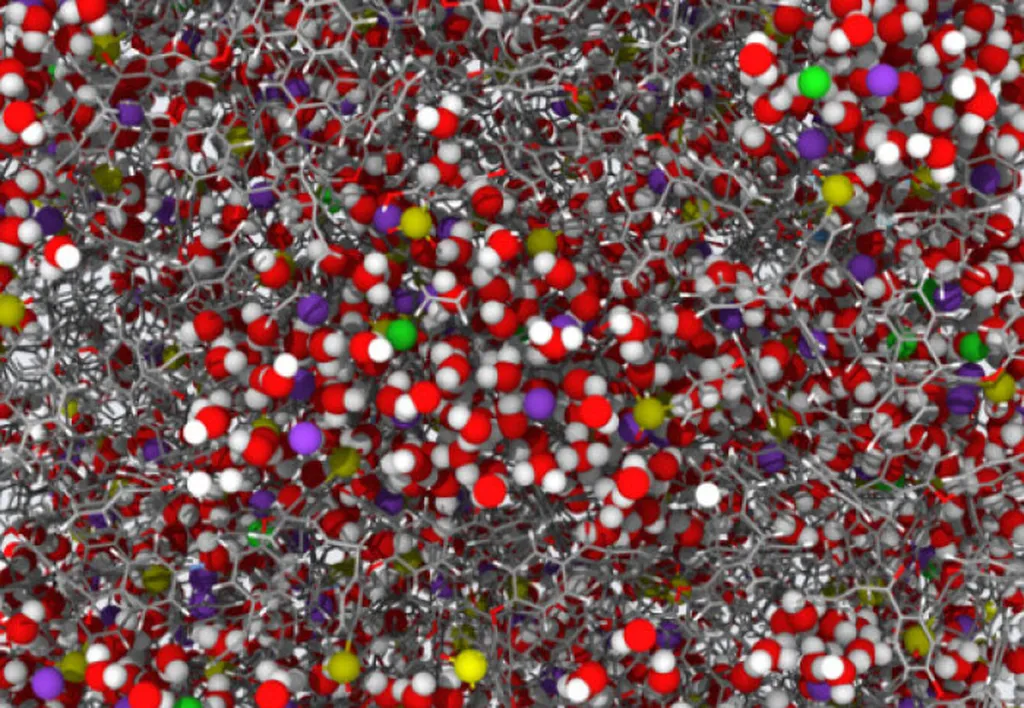
In the quest for cleaner energy solutions, researchers are continually pushing the boundaries of materials science, and a recent study published in *ACS Materials Au* (which translates to “ACS Materials Gold Open Access”) is making waves in the field of anion exchange membranes (AEMs). The research, led by Si Chen, delves into the intricate world of cations—specifically, N-Methylquinuclidinium and N,N-Dimethylpiperidinium—and their impact on the performance of AEMs, a critical component in various energy technologies.
Anion exchange membranes are at the heart of many emerging energy technologies, including fuel cells and electrolyzers, which are pivotal for the hydrogen economy. These membranes facilitate the movement of anions (negatively charged ions) and play a crucial role in converting chemical energy into electrical energy or vice versa. The choice of cations attached to the flexible side chains of these membranes can significantly influence their efficiency, durability, and overall performance.
Chen’s research compares two types of cations: N-Methylquinuclidinium and N,N-Dimethylpiperidinium. The study reveals that the structural differences between these cations can lead to variations in the membrane’s ion conductivity, mechanical stability, and resistance to degradation. “The choice of cation is not just a matter of chemistry; it’s about optimizing the entire system for real-world applications,” Chen explains. This nuanced understanding could pave the way for more efficient and cost-effective energy conversion devices.
The implications for the energy sector are profound. As the world shifts towards renewable energy sources, the demand for efficient energy storage and conversion technologies is on the rise. AEMs are a key player in this transition, and enhancing their performance can lead to more reliable and scalable energy solutions. “This research is a step towards unlocking the full potential of anion exchange membranes,” Chen adds, highlighting the broader impact of the findings.
The study published in *ACS Materials Au* not only advances our scientific understanding but also offers practical insights for industry professionals. By optimizing the cation structure, researchers and engineers can develop membranes that are better suited for commercial applications, ultimately driving down costs and improving the viability of clean energy technologies.
As the energy sector continues to evolve, innovations like these are crucial. They bridge the gap between laboratory research and real-world implementation, bringing us closer to a sustainable energy future. Chen’s work serves as a reminder that even the smallest changes at the molecular level can have a significant impact on the macro scale, shaping the technologies that will power our world tomorrow.