
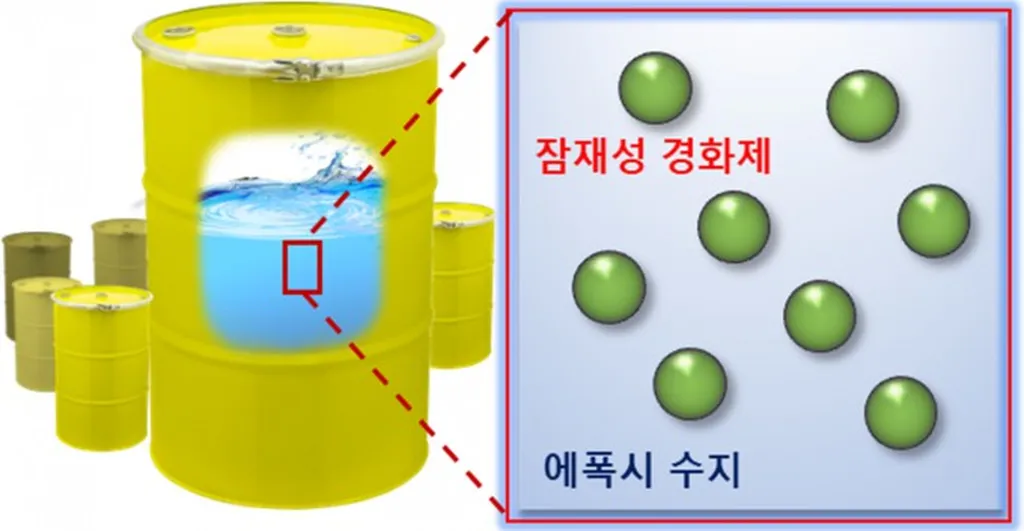
In a significant stride towards enhancing the safety and sustainability of epoxy resins, researchers have developed a novel approach to create fire-retardant and recyclable epoxy systems. This breakthrough, published in the journal *Materials Futures* (which translates to *Materials Horizons* in English), addresses longstanding challenges in the construction and energy sectors, where epoxy resins are widely used for their robustness and chemical resistance.
Epoxy resins (EPs) are indispensable in structural and functional applications, from wind turbine blades to electrical insulation in power grids. However, their inherent flammability and non-recyclability have posed substantial fire safety and environmental concerns. The research, led by Qingshan Yang from the Centre for Future Materials at the University of Southern Queensland in Australia, introduces a dynamic covalent chemistry approach that not only imparts flame retardancy but also enables recyclability.
“Traditionally, enhancing flame retardancy in epoxy resins has compromised their structural integrity, leading to issues like increased susceptibility to creep and deteriorated performance,” explains Yang. “Our work focuses on overcoming these trade-offs by integrating reversible dynamic covalent bonds that facilitate network adaptability without sacrificing mechanical properties, thermal stability, and durability.”
The study reviews recent advancements in flame-retardant, recyclable EPs and highlights strategies to improve creep resistance and in-service performance. By addressing these challenges, the research paves the way for safer and more sustainable applications in the energy sector. For instance, wind turbines, which rely heavily on epoxy resins for their blades, could benefit from materials that are both fire-resistant and recyclable, reducing environmental impact and enhancing safety.
“The potential for these materials is immense,” says Yang. “Imagine wind turbines that not only generate clean energy but are also safer and more environmentally friendly due to their recyclable, fire-retardant components. This is a significant step towards a more sustainable energy future.”
The research also proposes future development directions for creating flame-retardant, recyclable, and high-stability EPs, emphasizing the need for continued innovation in this field. As the energy sector increasingly prioritizes sustainability and safety, these advancements could revolutionize the way epoxy resins are utilized, ensuring they meet the evolving demands of modern infrastructure.
This groundbreaking work, published in *Materials Futures*, underscores the importance of interdisciplinary research in addressing critical challenges in materials science. By combining dynamic covalent chemistry with advanced flame-retardant strategies, the study offers a promising solution that could reshape the future of epoxy resins in the energy sector and beyond.