
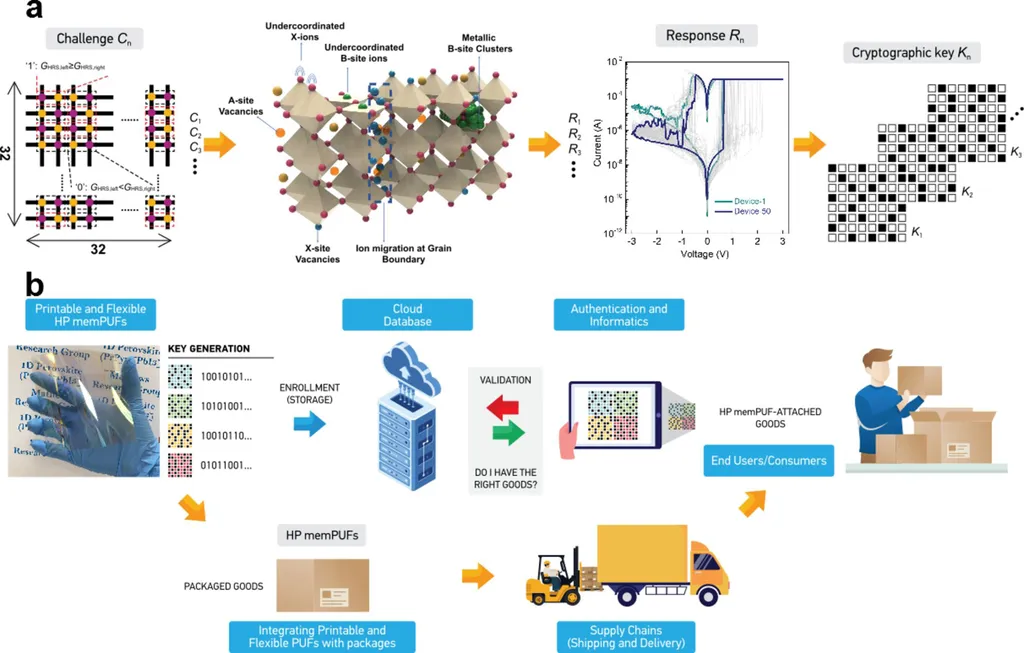
In the heart of Hong Kong, a team of researchers led by Shuanglong Wang from the Department of Electronic Engineering at The Chinese University of Hong Kong is making waves in the world of neuromorphic electronics. Their focus? Flexible perovskite memristors, a technology that could revolutionize the way we process and store data, with significant implications for the energy sector.
The von Neumann computing architecture, which has been the backbone of modern computing, is facing challenges. It’s characterized by physically separated processing and memory units, leading to excessive power consumption and limited data processing capabilities. Enter memristors, a novel nano-electronic device paradigm that integrates data storage and computing technology, promising to break through the von Neumann bottleneck.
Perovskite semiconductors, known for their structural tunability and exceptional electronic and optical properties, are at the forefront of this technological shift. When combined with mechanically robust substrates, they pave the way for flexible and lightweight neuromorphic systems. These systems could be game-changers in wearable electronics and the internet of things, areas where energy efficiency is paramount.
In their recent review published in *Materials Futures* (translated to English as *Materials Horizons*), Wang and his team provide a comprehensive overview of recent progress in flexible perovskite memristor technologies. They delve into optimization engineering for improving the resistive switching characteristics of memory devices and explore the role of perovskite-based flexible memories in neuromorphic applications, from artificial synapses to image recognition.
One of the key challenges highlighted in their research is the need to clarify the resistance-switching mechanism in perovskite memristors. “Understanding this mechanism is crucial for developing operationally stable perovskite-based flexible memristors,” Wang explains. This understanding could unlock the full potential of these devices in next-generation neuromorphic electronics, leading to more energy-efficient and powerful computing systems.
The implications for the energy sector are significant. As we move towards a more digitized and AI-driven world, the demand for high-performance, energy-efficient storage technologies is growing rapidly. Flexible perovskite memristors could be a key player in meeting this demand, enabling the development of more sustainable and efficient computing solutions.
However, challenges remain. As Wang notes, “Researchers face several hurdles in fabricating operationally stable perovskite-based flexible memristors.” Overcoming these challenges will be crucial for unlocking the full potential of this technology and shaping the future of neuromorphic electronics.
In the post-Moore era, the work of Wang and his team is not just about advancing technology; it’s about redefining the boundaries of what’s possible. Their research is a testament to the power of innovation and the potential of flexible perovskite memristors to transform the energy sector and beyond. As we stand on the brink of a new technological frontier, one thing is clear: the future of computing is flexible, efficient, and perovskite-powered.