
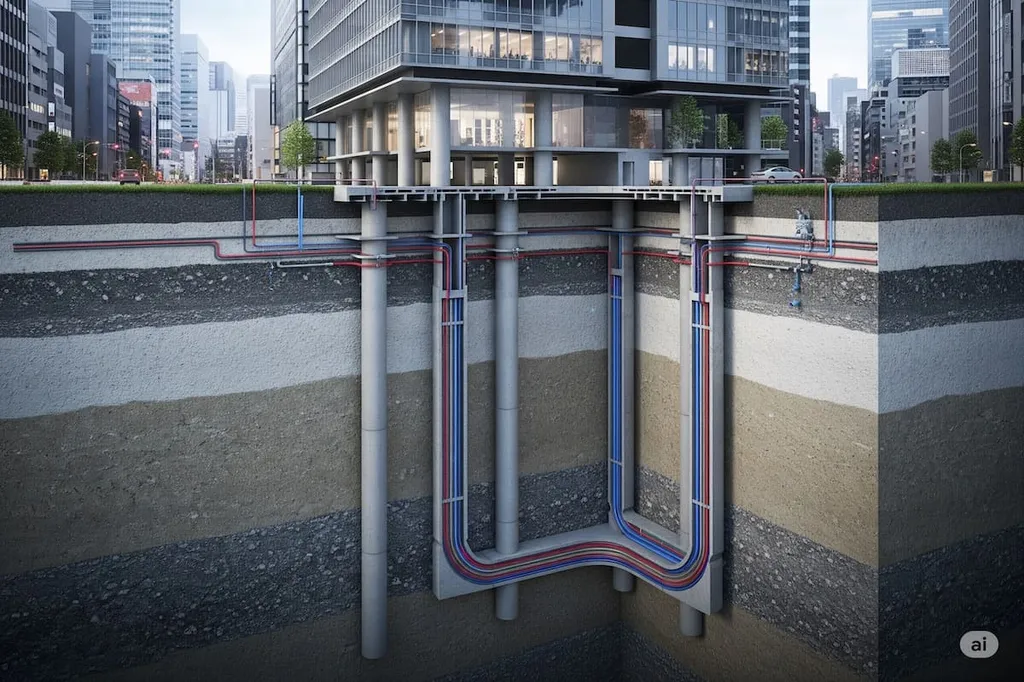
In the heart of bustling urban redevelopment, a silent revolution is taking place beneath our feet. As cities grow and change, the demand for pile removal has surged, presenting a unique set of challenges. Enter Haruka Kiyotomo, a researcher from the Takenaka Research & Development Institute in Chiba, Japan, who has developed a groundbreaking methodology to maintain construction accuracy and ground stability during urban redevelopment projects.
Kiyotomo’s innovative approach combines the simultaneous penetration and injection of a cement-bentonite (CB) slurry with mechanical mixing using an optimized auger system. This technique, detailed in a recent study published in *Cleaner Engineering and Technology* (which translates to *Cleaner Engineering and Technology* in English), aims to achieve controlled, uniform strength characteristics in backfilled zones following pile extraction.
The implications for the construction and energy sectors are significant. Urban redevelopment often involves the removal of old piles to make way for new infrastructure, such as buildings, roads, and energy facilities. Ensuring the stability and accuracy of these new structures is paramount. Kiyotomo’s methodology offers a reliable solution, particularly in cohesive clay ground conditions, with pile diameters ranging from 350 to 1000 millimeters and depths up to 20 meters.
“Through field implementation involving the removal of 350–400 millimeters diameter, 20 meters deep prestressed concrete piles, we achieved a mean unconfined compressive strength of over 100 kN/m² at 87% of the sampling locations,” Kiyotomo explained. This improved uniformity in strength characteristics is a game-changer, reducing the variability and uncertainty often associated with backfilling processes.
The study also found that new piles installed adjacent to backfilled zones maintained positional accuracy within acceptable tolerance limits (≤100 millimeters). However, Kiyotomo cautioned that the highest eccentricity values were observed in the approximate 3–8% overlap range. “This observation is purely descriptive and indicative,” she noted, “and is intended solely as a practical caution for future projects, not as a validated design criterion.”
The commercial impacts of this research are far-reaching. For the energy sector, which often requires extensive underground infrastructure, this methodology can ensure the stability and accuracy of new constructions. It can also minimize disruptions and delays, ultimately saving time and money.
Looking ahead, Kiyotomo’s research could shape future developments in the field by providing a reliable and efficient solution for urban redevelopment projects. As cities continue to grow and evolve, the demand for such innovative techniques will only increase. The study’s findings offer a promising path forward, ensuring that the foundations of our urban landscapes remain strong and stable.
In the words of Kiyotomo, “This methodology provides a reliable solution for urban redevelopment projects involving cohesive clay ground conditions.” And with further validation and refinement, it could become a standard practice in the construction and energy sectors, paving the way for safer, more efficient, and more sustainable urban development.