
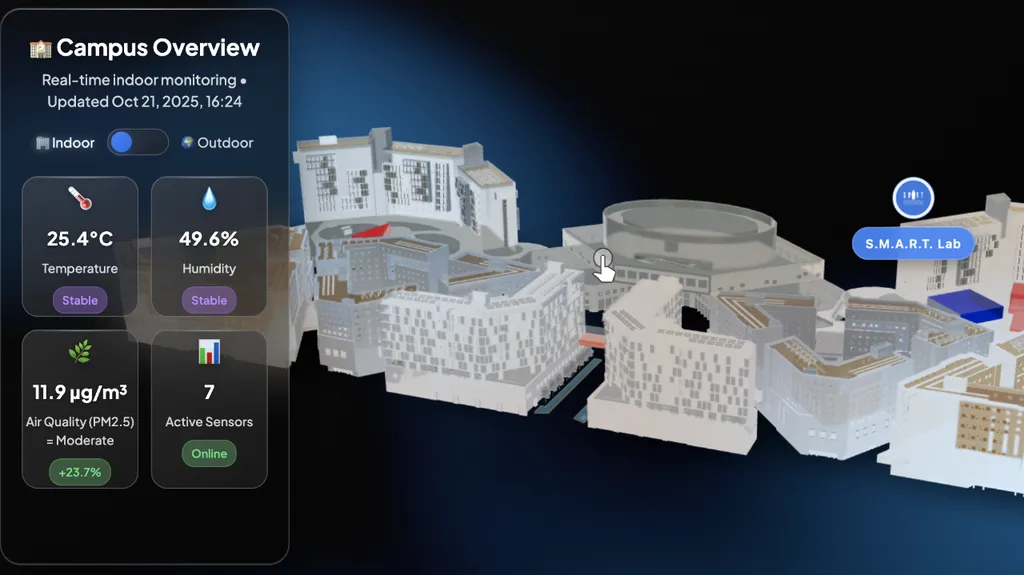
In the bustling heart of New York University Abu Dhabi (NYUAD) campus, a groundbreaking study is unfolding, poised to revolutionize how we manage and analyze buildings. Amanda Ramón-Constantí, a researcher from the Department of Architectural Graphic Expression at the Polytechnic University of Valencia in Spain, is leading the charge. Her work, recently published in *Frontiers in Built Environment* (which translates to *Frontiers in the Built Environment*), focuses on integrating Thermal Point Clouds (TPCs) into Building Information Models (BIM) and Geographic Information Systems (GIS). This integration could significantly enhance energy efficiency and building management, offering a tangible path to overcoming current format limitations.
The challenge has long been the lack of established methodologies and significant format interoperability issues. Ramón-Constantí’s research addresses this gap by developing and testing integration processes for both BIM and GIS platforms. “The goal is to make complex thermal data more accessible to professionals in the Architecture, Engineering, Construction, and Operation (AECO) sectors,” she explains. “By providing a structured workflow for interoperability, we can facilitate improved building management and more accurate energy analysis.”
The study involved two proofs of concept using data from a commercial scanner at the NYUAD campus. For BIM integration, Ramón-Constantí designed a process to generate open Industry Foundation Classes (IFC) files where average surface temperatures are embedded as native properties of architectural elements. For GIS integration, thermal data was assigned as custom attributes to a manually generated 3D geometric reference model, establishing the preliminary steps for a dedicated thermal-GIS workflow.
The methodologies were successfully validated through visualization in ArcGIS Pro and ACCA Software GeoTwin. The results demonstrate a tangible path to overcoming current format limitations, enabling the creation of multi-layer thermal digital twins. “This approach not only makes thermal data more accessible but also paves the way for more efficient energy analysis and building management,” Ramón-Constantí adds.
The implications for the energy sector are profound. By integrating thermal data into BIM and GIS environments, professionals can gain a more comprehensive understanding of building performance. This can lead to more informed decisions about energy use, ultimately reducing costs and improving sustainability. The study’s findings could shape future developments in the field, making it easier to create and manage multi-layer digital twins that incorporate thermal data.
As the built environment continues to evolve, the need for integrated, data-driven approaches becomes increasingly apparent. Ramón-Constantí’s research offers a compelling vision of how thermal data can be seamlessly integrated into existing workflows, providing a robust framework for the future of building management and energy analysis.