
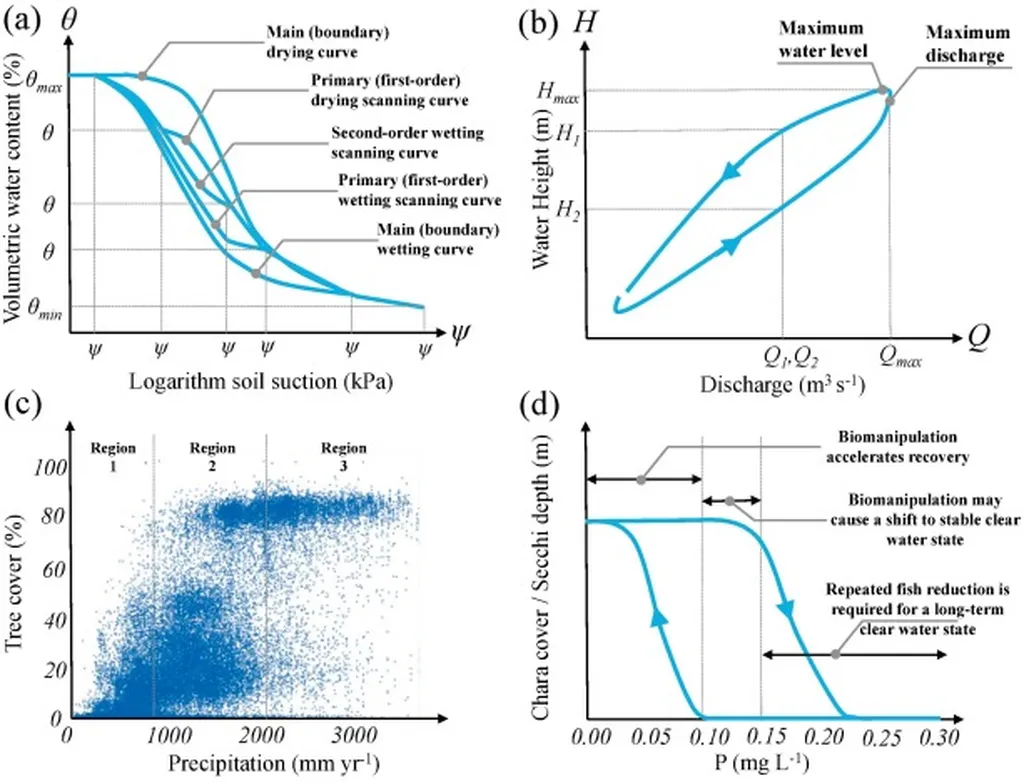
In the ever-evolving world of geotechnical engineering, a groundbreaking development has emerged from the halls of Beihang University in Beijing. Researchers YAO Yangping, WANG Fangyu, and WEI Ran from the School of Transportation Science and Engineering have introduced a novel model that promises to revolutionize our understanding of soil behavior under cyclic loading. Their work, published in the esteemed journal ‘Yantu gongcheng xuebao’ (translated to English as “Rock and Soil Engineering”), delves into the intricate world of soil hysteresis, offering a simpler, more unified approach to modeling the behavior of clays and sands.
The team’s research focuses on the hysteresis characteristic of soil, a phenomenon where the response of the material to cyclic loading is path-dependent, creating a loop in the stress-strain curve. This behavior is crucial for understanding the long-term performance of structures built on or within the ground, particularly in the energy sector where foundations for wind turbines, oil rigs, and other infrastructure are subjected to repeated loading cycles.
The researchers have developed a simple H-CSUH model that considers cyclic loading by constructing elastic hysteresis loops and improving low-stress plastic stiffness. “Our model introduces parameters κ0 and w to modify the elastic response of the unloading line, making it nonlinear and reflecting the initial unloading modulus and its change rate,” explains lead author YAO Yangping. This modification allows the model to exhibit complete elastic hysteresis behavior, a significant advancement in the field.
One of the most compelling aspects of this research is the establishment of a new hardening equation, denoted as Hh, through the construction of a multiplier ζ. This innovation improves the plastic stiffness of the model under low stress, making it more accurate and reliable. “Compared with existing models, our H-CSUH model has a simpler form and fewer parameters, achieving a unified description of the hysteretic behavior of clays and sands under cyclic loading,” YAO adds.
The implications of this research for the energy sector are substantial. Accurate modeling of soil behavior under cyclic loading is essential for designing safe and efficient foundations for energy infrastructure. With the H-CSUH model, engineers can better predict the long-term performance of these structures, leading to more informed decision-making and potentially significant cost savings.
The validity of the model has been confirmed through comparisons with drained and undrained test results across various types of clays and sands, demonstrating its broad applicability. As the energy sector continues to expand and evolve, the need for advanced geotechnical models like the H-CSUH will only grow. This research not only shapes future developments in the field but also underscores the importance of interdisciplinary collaboration in driving innovation.
In the words of YAO Yangping, “Our hope is that this model will serve as a valuable tool for engineers and researchers, helping to advance the field of geotechnical engineering and contribute to the development of more sustainable and resilient energy infrastructure.” With its publication in ‘Yantu gongcheng xuebao’, this groundbreaking research is set to make waves in the industry, paving the way for a new era of geotechnical modeling.