
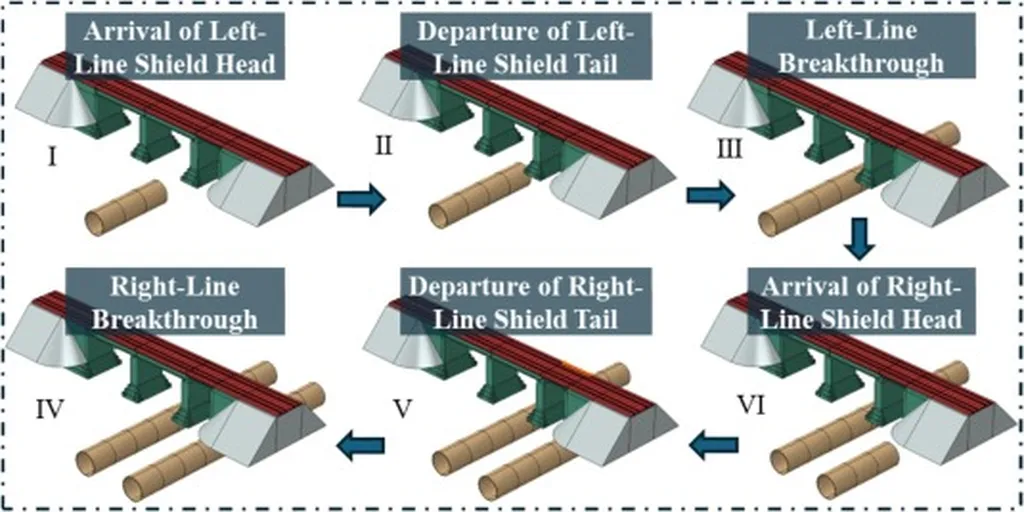
In the bustling world of urban infrastructure, the dance between new construction and existing structures is a delicate one. Nowhere is this more evident than in the realm of shield tunneling, where engineers must navigate the intricate ballet of building new tunnels beneath existing bridges. A recent study published in *Yantu gongcheng xuebao* (translated as *Rock and Soil Engineering*) by WANG Chao and colleagues from the School of Civil Engineering at Central South University in Changsha, China, sheds new light on this complex process, offering a method to determine the critical safe distance for shield tunnels crossing the pile foundations of existing bridges at orthogonal sides.
The study, which focuses on the pile-tunnel intermediate soil, employs the Pasternak two-parameter foundation model to establish equilibrium differential equations for horizontal displacements. This allows for the derivation of analytical solutions that can predict the behavior of the soil in these critical zones. “By understanding these displacements, we can better predict the stability of the system and ensure the safety of both the new tunnel and the existing bridge,” explains lead author WANG Chao.
The researchers also utilized the cusp catastrophe theory to determine the potential function of the pile-tunnel intermediate soil and the conditions under which the system might suddenly destabilize. This theoretical framework provides a robust method for calculating the critical safe distance, which is crucial for the design and construction of such projects.
The findings reveal that the critical safe distance is approximately an exponential function of the diameter ratio of the pile foundation of the bridge, with both parameters positively correlated. Additionally, the distance follows a quadratic function of the shield tunnel depth ratio, first increasing and then decreasing as the depth ratio increases, reaching a maximum value when the depth ratio of the shield tunnel is 8.1.
The practical implications of this research are significant, particularly for the energy sector, where underground infrastructure plays a vital role. “This method provides a scientific basis for the rational development of design and construction programs for similar tunnel crossing projects,” says WANG Chao. By ensuring the safety and stability of these structures, the method can help prevent costly delays and damages, ultimately benefiting both the construction industry and the energy sector.
The study’s findings were verified through numerical simulations and field measurements, demonstrating the engineering applicability of the proposed method. This research not only advances our understanding of the interactions between pile foundations and shield tunnels but also offers a practical tool for engineers and planners. As urbanization continues to drive the demand for underground infrastructure, such advancements are invaluable.
In the words of WANG Chao, “This research is a step forward in ensuring the safety and efficiency of our underground construction projects, paving the way for more sustainable and resilient urban development.” With the growing complexity of urban environments, the insights gained from this study will undoubtedly shape future developments in the field, ensuring that the dance between new construction and existing structures continues to be a harmonious one.