
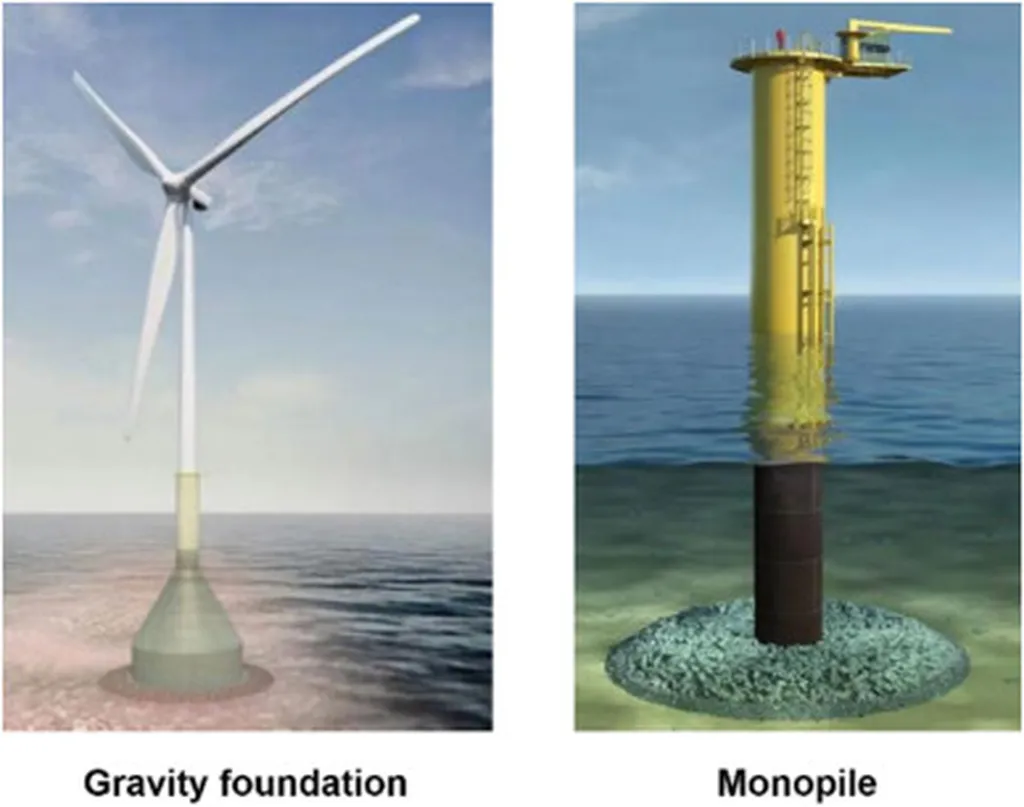
In the quest to harness the power of offshore winds, engineers face a formidable challenge: designing foundations that can withstand the immense forces exerted by these towering turbines. A recent study published in *Yantu gongcheng xuebao* (translated as “Rock and Soil Mechanics”) sheds new light on the behavior of large-diameter monopiles, the most common foundation type for offshore wind turbines. The research, led by WANG Wei from the Institute of Science and Technology at China Three Gorges Corporation, explores how varying the embedment depth of these monopiles affects their performance under lateral loading.
The study combines centrifuge tests and numerical simulations to investigate the small-displacement behavior of 9-meter-diameter monopiles with different embedment depths. The findings reveal that as the embedment depth increases, the rotation center of the monopile gradually moves downward. Moreover, the nonlinear characteristics of lateral displacement and rotation angle distributions along the pile become more pronounced.
One of the most significant insights from the research is the changing nature of the p-y curve—the relationship between soil reaction (p) and pile deflection (y)—with increasing embedment depth. “The p-y curve changes from convex to concave as the embedment depth increases,” explains WANG Wei. “This has important implications for the design and optimization of monopile foundations.”
The study also highlights the substantial variation in the initial secant modulus at the same depth among monopiles with different embedment depths. This modulus can differ by up to four times, indicating a significant impact on the horizontal resistance of the piles. The researchers attribute this to the influence zone of radial and circumferential displacements in the surrounding soil, which is smaller for monopiles with shallower embedment depths, leading to larger soil strain and, consequently, greater horizontal resistance.
The commercial implications of this research are substantial. Offshore wind energy is a rapidly growing sector, with governments and corporations worldwide investing heavily in this renewable energy source. The optimization of monopile designs can lead to significant cost savings and improved structural integrity, making offshore wind farms more economically viable and efficient.
As the energy sector continues to evolve, understanding the load-transfer mechanisms of large-diameter monopiles becomes increasingly crucial. This research provides a theoretical basis for the optimization of design approaches, potentially shaping the future of offshore wind power foundations. “Our findings contribute to a deeper understanding of how monopiles interact with the soil, which is essential for developing more robust and cost-effective designs,” adds WANG Wei.
With the insights gained from this study, engineers and researchers can refine their models and designs, ensuring that offshore wind turbines are not only powerful but also stable and durable. As the world turns to renewable energy sources to combat climate change, such advancements are invaluable in driving the energy transition forward.