
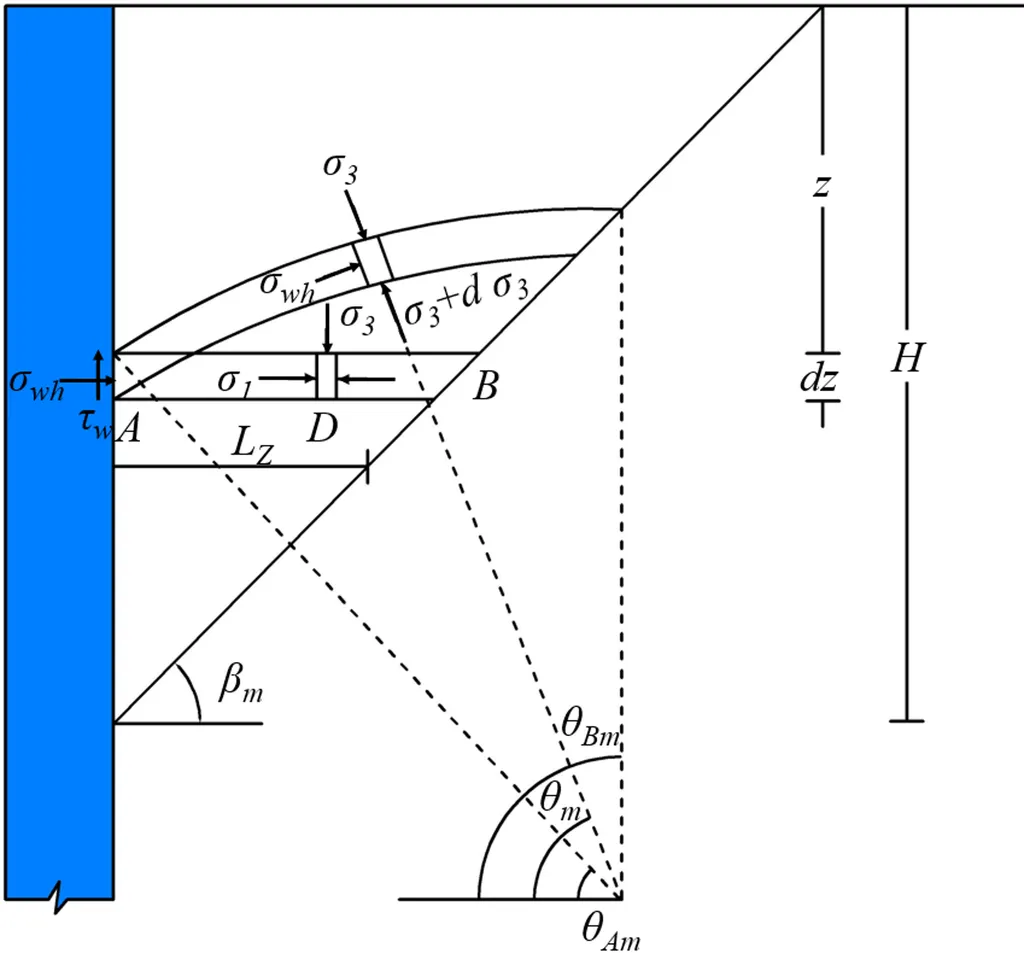
In the world of geotechnical engineering, understanding the behavior of soils under various conditions is paramount, especially when it comes to the interaction between soils and structures. A recent study published in *Yantu gongcheng xuebao* (Chinese Journal of Geotechnical Engineering) sheds new light on the calculation of loosening earth pressure in deep trapdoor tests, particularly in unsaturated sandy soils. This research, led by ZHAO Yun from the College of Civil Engineering and Architecture at Henan University of Technology and YANG Zhongfang from the MOE Key Laboratory of Soft Soils and Geoenvironmental Engineering at Zhejiang University, could have significant implications for the energy sector and other industries that deal with soil-structure interactions.
The study focuses on the soil-arching effect, a phenomenon where soil forms an arch-like structure above a void or a weak zone, redistributing the load and affecting the earth pressure. Traditional models and solutions for loosening earth pressure have primarily concentrated on dry and fully saturated soils, leaving a gap in understanding for the unsaturated conditions commonly encountered in real-world engineering projects.
“Unsaturated soils are prevalent in many engineering scenarios, yet they have been largely overlooked in the context of soil arching and loosening earth pressure,” noted ZHAO Yun, the lead author of the study. “Our research aims to bridge this gap by providing a comprehensive analytical model that considers the effects of soil saturation.”
The researchers conducted a series of numerical deep trapdoor tests using ABAQUS finite element software to study soil failure mechanisms under varying saturation levels. They then developed an analytical model for calculating loosening earth pressure, combining the major principal arc arch theory with the shear strength theory of unsaturated soils. The proposed model was validated through comparisons with unsaturated trapdoor tests, existing analytical solutions, and numerical simulations.
The findings reveal that the loosening earth pressure initially decreases with increasing soil saturation but then increases after reaching a critical saturation point, with the minimum value occurring at this critical point. Additionally, as the relative depth ratio increases, the loosening earth pressure shows a slowly decreasing trend.
“This research provides a more accurate and nuanced understanding of how unsaturated soils behave under different conditions,” said YANG Zhongfang, a co-author of the study. “It offers valuable insights for engineers and researchers working on projects involving soil-structure interactions, particularly in the energy sector where underground storage and excavation are common.”
The implications of this research are far-reaching. In the energy sector, for instance, understanding the behavior of unsaturated soils can enhance the design and safety of underground storage facilities, tunnels, and foundations for renewable energy projects. It can also improve the accuracy of soil arching models used in the analysis of soil-structure interactions, leading to more efficient and cost-effective engineering solutions.
As the world continues to push the boundaries of geotechnical engineering, studies like this one pave the way for innovative approaches and technologies that can withstand the challenges posed by complex soil conditions. The research not only advances our scientific understanding but also has the potential to shape future developments in the field, ensuring safer and more sustainable engineering practices.
For professionals in the energy sector and beyond, this study serves as a reminder of the importance of considering unsaturated soil conditions in their projects. By leveraging the insights gained from this research, they can make more informed decisions, ultimately leading to better outcomes and reduced risks.
In a rapidly evolving field, staying ahead of the curve is crucial. This study, published in *Yantu gongcheng xuebao*, offers a significant step forward in our understanding of soil behavior, setting the stage for future advancements in geotechnical engineering.