
In the realm of underground engineering, where the service life of structures can span decades, understanding the behavior of surrounding rock is paramount. A recent study published in *Yantu gongcheng xuebao* (Chinese Journal of Geotechnical Engineering) sheds light on the intricate relationship between creep deformation and permeability in rocks, offering insights that could revolutionize the energy sector.
Led by Liu Xueying from the Fujian Engineering Technology Research Center for Tunnel and Underground Space at Huaqiao University, the research introduces an anisotropic creep-permeability model for rock. This model is a significant step forward in predicting how rocks behave under long-term stress and water exposure, factors critical in the stability and longevity of underground structures such as oil and gas reservoirs, geothermal plants, and nuclear waste repositories.
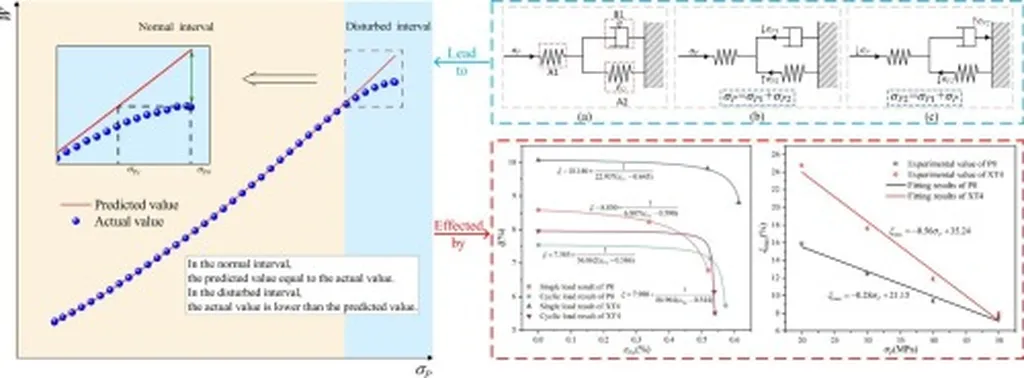
The study simplifies the rock into a cube model and establishes a creep permeability model in stages. “At the viscoelastic stage, we defined the ratio of viscosity coefficients between cracks and rocks and introduced a lateral influence coefficient to represent the influence of lateral stress on crack opening,” explains Liu. This stage is crucial for understanding how rocks compact over time, affecting their permeability.
In the viscoplastic stage, the researchers defined a correction coefficient to represent the influences of cracks on seepage channels. This stage is particularly relevant for the energy sector, as it helps predict how permeability changes under different stress conditions, which is vital for the efficient extraction of resources.
The model was validated through creep-seepage tests under true triaxial conditions, demonstrating higher accuracy compared to traditional models. “The proposed model can describe the trend that the permeability decreases due to the gradual compaction of pores and cracks at the viscoelastic stage, and it increases suddenly caused by the gradual convergence of cracks at the accelerated creep stage,” says Liu.
The implications for the energy sector are profound. Understanding how permeability evolves under different conditions can lead to more efficient and safer extraction methods. For instance, in geothermal energy, where hot water is extracted from underground reservoirs, knowing how permeability changes over time can optimize the extraction process and extend the life of the reservoir.
Moreover, the sensitivity analysis conducted on the parameters in the anisotropic creep-permeability model provides valuable insights. As the viscosity coefficient ratio increases, the permeability decays fast, and the stable permeability decreases. This information is crucial for designing underground structures that can withstand long-term stress and water exposure.
The research also highlights the importance of considering orthogonal anisotropy in permeability models. This factor is often overlooked but can significantly impact the accuracy of predictions. By incorporating this aspect, the model offers a more comprehensive understanding of rock behavior.
In conclusion, this study is a significant advancement in the field of underground engineering. It provides a more accurate and comprehensive model for predicting rock behavior, which can lead to more efficient and safer extraction methods in the energy sector. As Liu puts it, “This model can be used to describe the trend that the permeability decreases due to the gradual compaction of pores and cracks at the viscoelastic stage, and it increases suddenly caused by the gradual convergence of cracks at the accelerated creep stage.” This insight is invaluable for the energy sector, where understanding and predicting rock behavior is crucial for the efficient extraction of resources.
The research was published in *Yantu gongcheng xuebao*, a leading journal in the field of geotechnical engineering, further emphasizing its significance and relevance. As the energy sector continues to evolve, this model will undoubtedly play a pivotal role in shaping future developments and ensuring the stability and longevity of underground structures.