
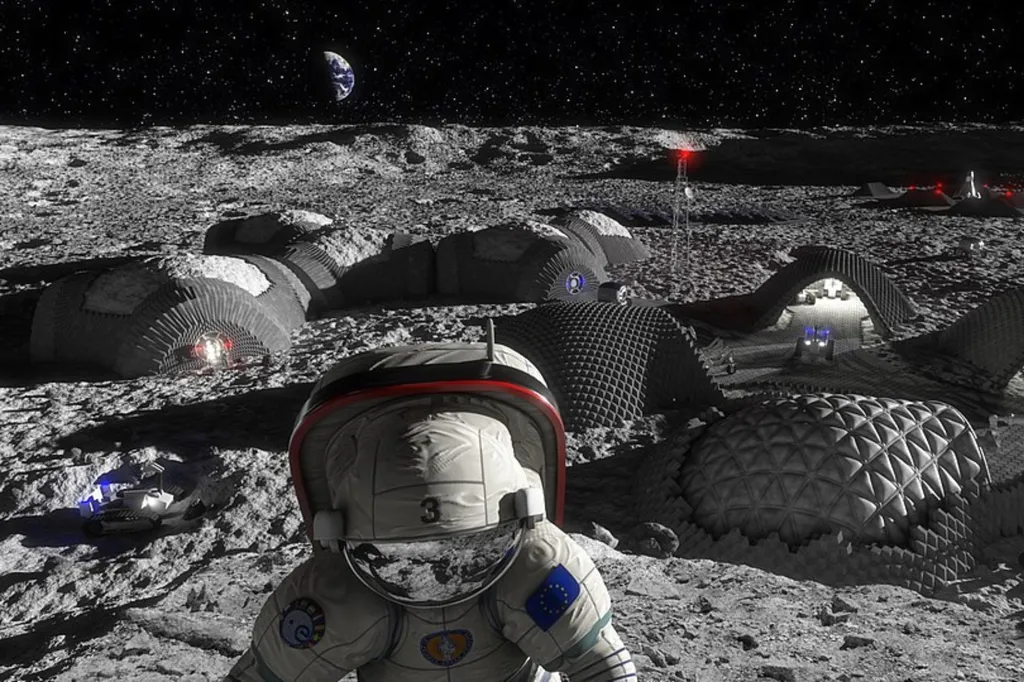
In the vast expanse of space, the lunar surface holds secrets that could unlock new frontiers for resource utilization and construction, particularly for the energy sector. A recent study published in *Yantu gongcheng xuebao* (Chinese Journal of Geotechnical Engineering) delves into the unique characteristics of lunar regolith, the layer of loose, fragmented material covering the moon’s surface. Led by Dr. Shi Anning from Tianjin University and Dr. Jiang Mingjing from Suzhou University of Science and Technology, the research employs the distinct element method (DEM) to explore the static and flow mobility characteristics of lunar regolith, with significant implications for future lunar missions and in-situ resource utilization.
The study focuses on the distinct grain shape characteristics of lunar regolith, particularly those collected during the Chang’E-5 mission. “Understanding the behavior of lunar regolith is crucial for selecting base station locations and constructing infrastructure on the moon,” Dr. Shi Anning explained. The researchers utilized a three-dimensional contact model to reproduce the macroscopic static and flow behaviors of lunar regolith samples, determining key shape parameters for different grain sizes.
Through triaxial tests under varying confining pressures and rotating drum tests at different speeds, the team compared the static and flow mobility characteristics of lunar regolith with Toyoura sand and glass beads. The results revealed that lunar regolith exhibits unique properties, including larger apparent cohesion, internal friction angle, and inclination angle, as well as a smaller shearing rate and coordination number. “These findings indicate that lunar regolith has the smallest flow mobility, which is essential for understanding its behavior in different engineering applications,” Dr. Jiang Mingjing noted.
The implications of this research are far-reaching, particularly for the energy sector. As space agencies and private companies eye the moon for resource extraction and construction, understanding the mechanical properties of lunar regolith is vital. The study’s findings could inform the design of equipment and structures for lunar missions, ensuring stability and efficiency in resource utilization.
Moreover, the research highlights the importance of considering the unique characteristics of lunar regolith in future lunar exploration. “Our study provides a foundation for further research into the behavior of lunar regolith under various conditions, paving the way for innovative solutions in space construction and resource management,” Dr. Shi Anning added.
As the world looks to the stars for new opportunities, this groundbreaking research offers valuable insights into the challenges and possibilities of lunar exploration. With the energy sector increasingly interested in space-based resources, the findings could shape the future of off-world construction and resource utilization, bringing us one step closer to unlocking the mysteries of the moon.