
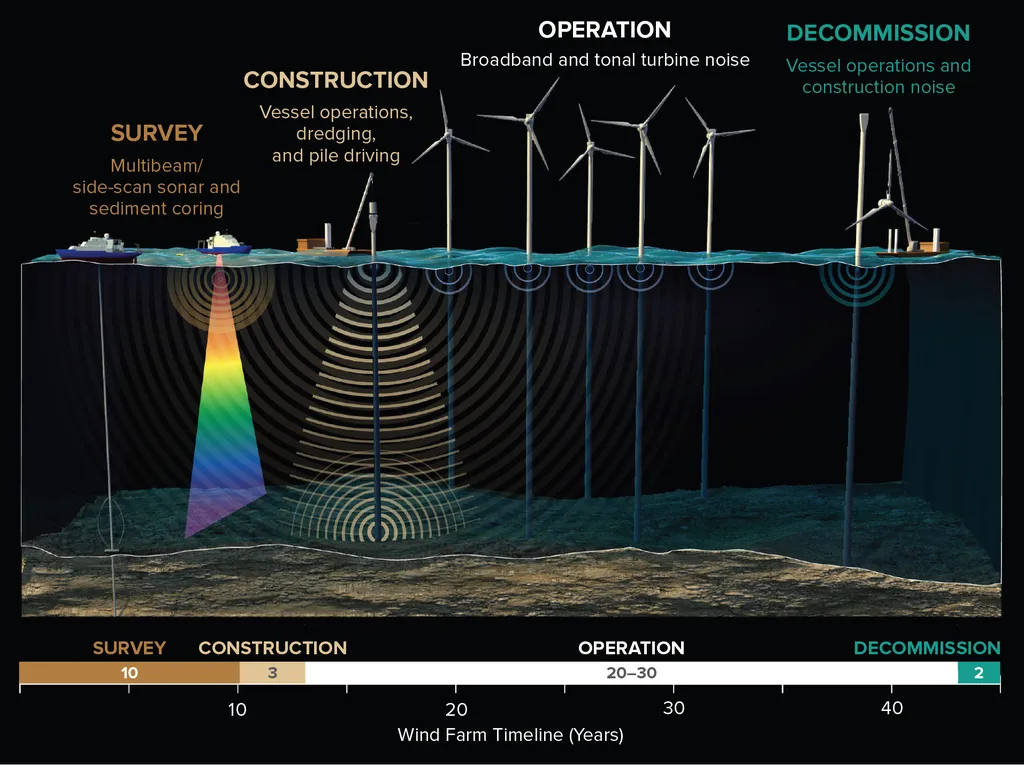
In the relentless pursuit of sustainable energy, offshore wind power stands as a beacon of hope, but the structures that harness this power must withstand the relentless forces of nature. A recent study published in *Yantu gongcheng xuebao* (translated as *Journal of Geotechnical Engineering*) sheds light on the dynamic characteristics of offshore wind power structures with bucket foundations, offering crucial insights for the energy sector.
The research, led by CAI Zhengyin of the Geotechnical Engineering Department at Nanjing Hydraulic Research Institute, delves into the complex environmental loads that offshore wind power structures endure over their lifetime. By analyzing in-situ test data from a composite bucket foundation in Rudong County, Jiangsu Province, the team identified structural modal parameters under various environmental excitations.
“Our findings reveal that the modal frequency and damping ratio of offshore wind power structures follow a normal distribution, with a notable degree of dispersion,” CAI explained. The study found that the modal frequency and damping ratio in the radial direction were concentrated within specific ranges, highlighting the critical role of wind load in the vibration characteristics of these structures.
One of the most significant discoveries was the negative correlation between modal frequency and wind speed, and the positive correlation between modal radial damping ratio and wind speed. As wind speed increased, the correlation coefficient also rose, particularly when wind speeds exceeded 7 m/s. This insight could be pivotal for engineers designing and maintaining offshore wind turbines, ensuring they can withstand the dynamic forces they encounter.
The research also uncovered that modal frequency degradation is primarily concentrated in the first 150 days of the test period, reflecting the decline in the constraint effects of the soil on the bucket foundation. “The weakening of the foundation-soil contact effects is the main reason for the degradation of the modal frequency,” CAI noted. This understanding could lead to more robust designs and better maintenance strategies, ultimately enhancing the longevity and efficiency of offshore wind power structures.
The implications of this research are far-reaching for the energy sector. By providing a deeper understanding of the dynamic characteristics of offshore wind power structures, it paves the way for more resilient and efficient designs. This could lead to reduced maintenance costs, increased energy output, and a more reliable energy supply, all of which are crucial for the commercial viability of offshore wind power.
As the world continues to shift towards renewable energy sources, studies like this one are invaluable. They not only advance our scientific understanding but also drive technological innovation and commercial success in the energy sector. With the insights gained from this research, the future of offshore wind power looks brighter and more promising than ever.