
In the high-stakes world of open-pit mining, where the stability of rock slopes is paramount to safety and productivity, a groundbreaking study offers a new approach to early warning systems for landslides. Published in the journal *Yantu gongcheng xuebao* (translated as *Rock and Soil Engineering*), the research led by LIU Feiyue from the Anhui Province Key Laboratory of Intelligent and Green Mining of Deep Coal Resources at Anhui University of Science and Technology, in collaboration with colleagues from Northeastern University and Tianjin University, introduces a method that could revolutionize how mines monitor and respond to potential rockfalls.
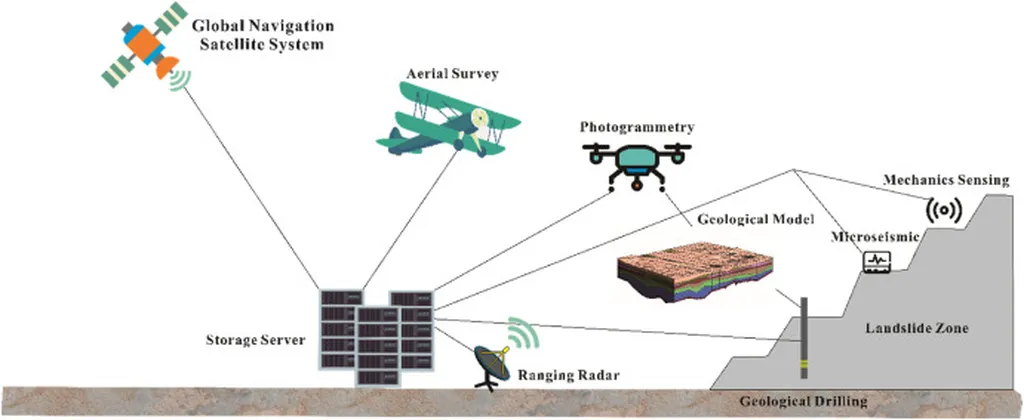
The study, which analyzed 32 rock landslide cases in open-pit mines, reveals that rockfalls or slope movements often serve as precursors to larger landslides. By leveraging the abundance of monitoring videos collected in accordance with safety standards, the researchers utilized a motion target tracking algorithm to identify these early warning signs. This algorithm can detect rockfalls or slope movements, providing early warnings with lead times ranging from tens of seconds to hours before a landslide fully develops.
“By setting appropriate thresholds, we can provide early warnings for areas where landslides have initiated but not yet spread,” explains LIU Feiyue. “This method holds extensive application prospects in open-pit mines, significantly enhancing safety and operational efficiency.”
The research demonstrated the effectiveness of this approach at an undisclosed open-pit quarry and the Yanshan open-pit mine. The findings indicate that rock landslides progress through four distinct phases: occasional rockfall, small-scale rockfall, continuous rockfall, and overall landslide. For landslides with heights of 6 meters and 30 meters, the early warning leading times were 35 seconds and 113 seconds, respectively.
The implications for the energy sector are substantial. Open-pit mines are critical for extracting coal, minerals, and other resources that fuel global industries. The ability to predict and mitigate landslides can prevent costly disruptions, protect workers, and ensure the continuity of operations. As the demand for resources continues to grow, the adoption of such early warning systems could become a standard practice, shaping the future of mining safety and efficiency.
While the method shows great promise, the researchers emphasize the need for extensive field tests and further research to refine and validate the approach. “This is a significant step forward, but we must continue to test and improve the system to ensure its reliability and effectiveness in various mining environments,” adds LIU Feiyue.
As the mining industry continues to evolve, the integration of advanced technologies like motion tracking algorithms could redefine safety protocols and operational strategies. This research not only highlights the potential of video monitoring but also underscores the importance of innovation in maintaining the safety and productivity of open-pit mines.