
In the rapidly evolving energy sector, the integration of photovoltaic (PV) systems and electrical energy storage (EES) is pivotal for decarbonizing buildings and communities. However, the complexity of planning these integrated systems has long been a hurdle, with existing tools often falling short of providing a comprehensive solution. Enter DORES, a groundbreaking simulation tool developed by Sofiane Kichou and his team at the Czech Technical University in Prague, University Centre for Energy Efficient Buildings. Published in the journal *Energy Conversion and Management: X* (translated to English as *Energy Conversion and Management: Next Generation*), this innovative software is set to revolutionize the way we approach PV-storage integration.
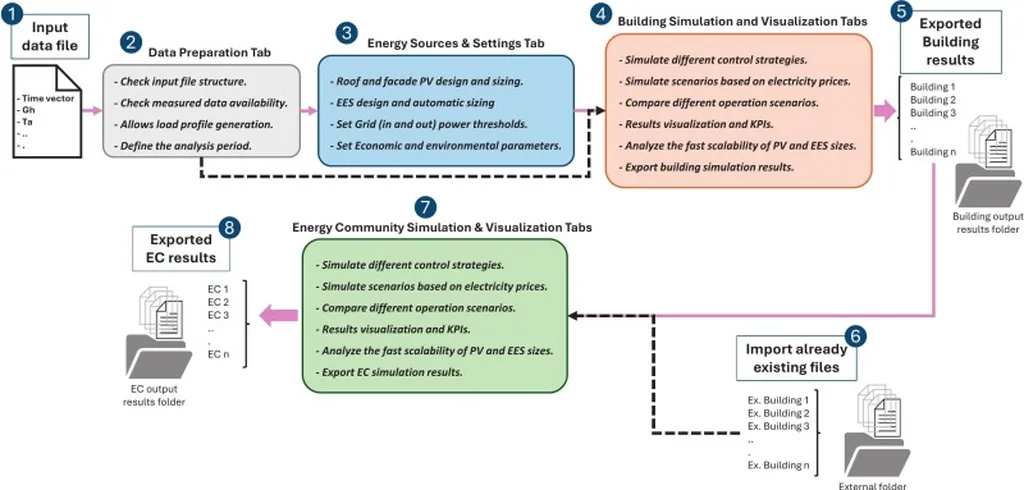
DORES stands out by addressing the multifaceted challenges of solar variability, battery degradation, and economic uncertainty. Unlike existing tools that focus on isolated aspects such as PV yield or microgrid optimization, DORES combines technical, economic, and environmental indicators across both building and community scales. This holistic approach is crucial for informed decision-making in the energy sector.
“DORES is designed to be modular and user-friendly, making it accessible for a wide range of users,” explains Kichou. “It models load profiles, PV systems, and batteries, and implements multiple energy management strategies, from rule-based control to optimization-based methods that include battery wear costs.”
The software automatically calculates key performance indicators such as self-sufficiency, self-consumption, net present value, life cycle cost, and CO2 savings through a graphical interface developed in MATLAB. Validation against monitored data and a benchmark commercial tool, PV*SOL, shows high accuracy, with deviations in key indicators typically below 5%.
One of the most compelling features of DORES is its ability to enable scenario testing at the community scale. This capability supports aggregated prosumer systems and shared storage assessment, making it an invaluable tool for energy communities. “This tool is not just about optimizing individual systems; it’s about creating a more sustainable and efficient energy ecosystem,” adds Kichou.
The commercial implications of DORES are significant. By providing a comprehensive and accurate simulation tool, it empowers energy professionals to make data-driven decisions that can enhance the efficiency and economic viability of PV-storage systems. This, in turn, can accelerate the adoption of renewable energy technologies, contributing to the broader goal of decarbonization.
As the energy sector continues to evolve, tools like DORES will play a crucial role in shaping future developments. By offering a streamlined and integrated approach to PV-storage planning, DORES sets a new standard for energy management strategies, paving the way for a more sustainable and efficient energy future.