
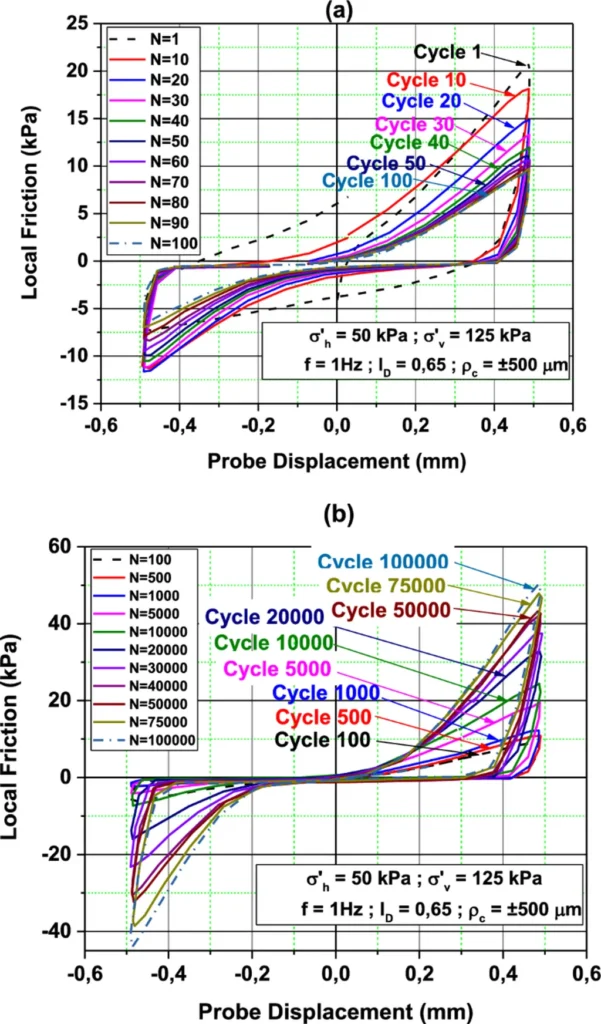
In a groundbreaking study published in the journal *Yantu gongcheng xuebao* (translated to *Rock and Soil Mechanics*), researchers from the Dalian University of Technology and Changzhou University have uncovered a unique property of sand that could revolutionize how we understand and predict soil behavior under cyclic loading. This discovery holds significant implications for the energy sector, particularly in the design and stability of foundations for offshore wind turbines, oil and gas platforms, and other critical infrastructure.
The research, led by Dr. Shao Longtan from the State Key Laboratory of Structural Analysis for Industrial Equipment at Dalian University of Technology, explores the consistency of stress-strain envelope curves of sand under various cyclic loading conditions. The team conducted a series of triaxial compression tests on silica powder and Fujian standard sand, employing a full-surface digital image measurement system to capture precise data.
“What we found is quite remarkable,” said Dr. Shao. “The stress-strain curves of soil samples with the same density and confining pressure are approximately consistent, regardless of the different cyclic stress processes they undergo. This suggests a unique property of sand that we term the ‘uniqueness of the stress-strain envelope curves.'”
This consistency implies that the behavior of sand under cyclic loading can be predicted with greater accuracy, which is crucial for the energy sector. For instance, offshore wind turbines and oil rigs are subjected to constant cyclic loading from waves and winds. Understanding how sand behaves under these conditions can lead to more stable and durable foundation designs, reducing maintenance costs and enhancing safety.
Dr. Gao Rui, a co-author of the study, emphasized the practical applications of their findings. “By understanding the uniqueness of these stress-strain envelope curves, we can develop more accurate models for predicting axial strain accumulation in sand. This is particularly important for the energy sector, where the stability of foundations is paramount.”
The research also delves into the influences of cyclic stress history and stress level on the regression velocity of the curves. This deeper understanding can help engineers design more resilient structures that can withstand varying stress conditions over time.
The study’s findings were published in *Yantu gongcheng xuebao*, a prestigious journal in the field of geotechnical engineering. The research not only advances our fundamental understanding of soil mechanics but also paves the way for innovative applications in the energy sector.
As the energy industry continues to push the boundaries of technology and infrastructure, this research provides a crucial piece of the puzzle. By leveraging the unique properties of sand, engineers can design more efficient and reliable foundations, ensuring the stability and longevity of critical energy infrastructure.
In the words of Dr. Shao, “This is just the beginning. Our findings open up new avenues for research and application, and we are excited to see how this knowledge will shape the future of geotechnical engineering and the energy sector.”