
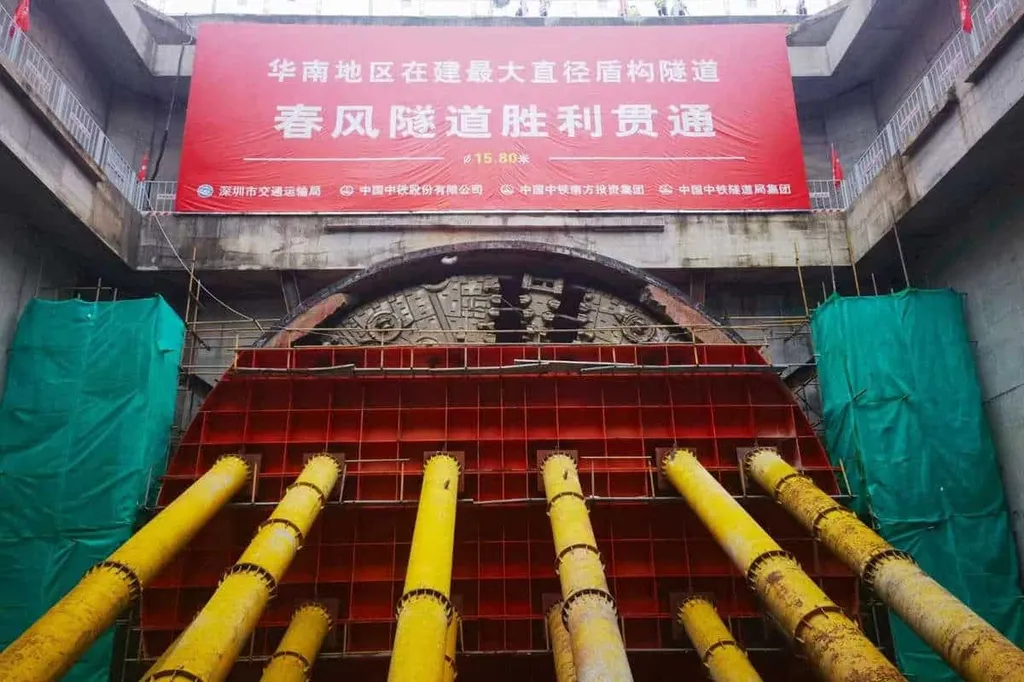
In the heart of China, a team of researchers led by Dr. Li Zhen from Shandong University has been delving into the intricate world of slurry shield tunneling, a critical process in the construction of tunnels, particularly in the energy sector. Their work, published in the journal *Yantu gongcheng xuebao* (which translates to *Rock and Soil Mechanics*), sheds light on the sedimentation characteristics of gravel in the discharge pipe of slurry shield tunneling and its impact on slurry, offering insights that could revolutionize the industry.
Slurry shield tunneling is a complex process that involves the use of a slurry to support the excavation face and transport the excavated material. However, this process is not without its challenges, particularly when it comes to the transportation of gravel. “The slurry shield tunneling in weathered rock layers is prone to gravel accumulation within the slurry pipe,” explains Dr. Li, the lead author of the study. This accumulation can lead to sedimentation blockage, causing significant delays and cost overruns.
To tackle this issue, Dr. Li and his team established a model of gravel transportation in the slurry pipe using the computational fluid dynamics-discrete element (CFD-DEM) coupling method. This innovative approach allowed them to analyze the velocity distribution, force characteristics, and motion forms of gravel during transportation, as well as the influences of gravel bed deposition on the slurry.
Their findings are groundbreaking. They discovered that gravel particles move intermittently in a sand dune-like bed. The velocity of the gravel is layered along the height, with the surface gravel velocity being fast, characterized by collision and rolling as the main movements. In contrast, the velocity of gravel in the near wall layer is slow, and its movement is mainly dominated by sliding.
The study also explored the effects of various factors on the sedimentation characteristics of gravel. They found that the velocity of the gravel bed increases linearly with the increase of the slurry flow rate, and the height of the gravel bed increases with the size of the gravel. Moreover, the higher the density of the slurry, the greater the drag force on the gravel. The smaller the gravel shape factor, the greater the difficulty of transportation.
The commercial implications of this research are significant, particularly for the energy sector. Tunneling is a critical process in the construction of energy infrastructure, such as hydroelectric power plants and underground energy storage facilities. The insights gained from this study could lead to the development of more efficient and cost-effective tunneling methods, reducing the risk of sedimentation blockage and improving the overall efficiency of the process.
Dr. Li and his team have also established risk assessment indices for gravel sedimentation and proposed targeted control methods. These findings provide a valuable reference for preventing and treating sedimentation blockage of gravel, paving the way for future developments in the field.
As we look to the future, the work of Dr. Li and his team offers a glimpse into the potential of advanced modeling techniques in tackling complex engineering challenges. Their research not only advances our understanding of slurry shield tunneling but also opens up new avenues for innovation in the energy sector. The journey towards more efficient and sustainable energy infrastructure has taken a significant step forward, thanks to the dedication and ingenuity of these researchers.