
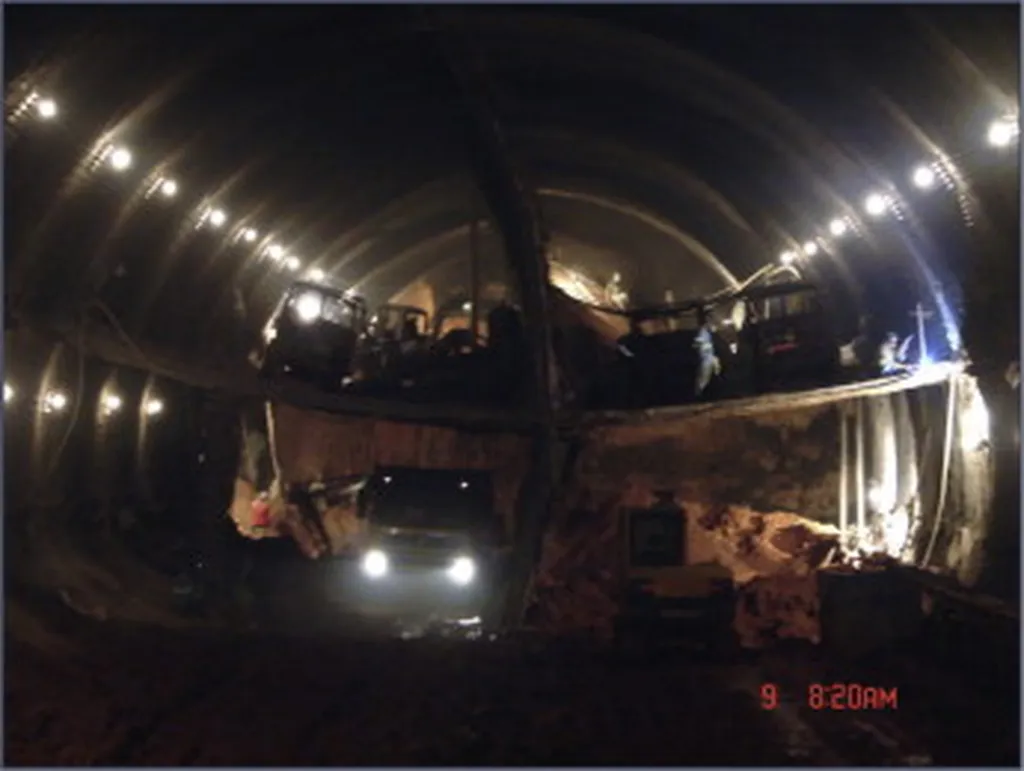
In the heart of China, a team of researchers from Shandong University has developed a groundbreaking grouting material that could revolutionize tunnel construction and disaster management in the energy sector. Led by Dr. Yang Lei from the Research Center of Geotechnical and Structural Engineering, the team has created a high-strength acrylic salt grouting material that promises to tackle the challenges posed by water-rich and weak surrounding rock, particularly ultracataclasite.
The new material, detailed in a recent study published in *Yantu gongcheng xuebao* (translated to *Journal of Geotechnical Engineering*), addresses the limitations of conventional grouting materials, which often struggle with the complexities of water-rich environments. “Our goal was to develop a material that could not only withstand the harsh conditions but also enhance the stability of the surrounding rock,” said Dr. Yang Lei, the lead author of the study.
The high-strength acrylic salt grouting material is composed of a main agent, inorganic modifier, initiator, accelerator, and crosslinking agent. This unique composition allows for a polymerization reaction that creates an organic-inorganic interpenetrating network, resulting in a material with remarkable strength and permeability. According to the researchers, the material’s uniaxial compressive strength ranges from 1.2 to 2.1 MPa, with a water absorption expansion rate of 16% to 51%.
One of the most significant findings of the study is the material’s superior permeability and reinforcement characteristics. “The permeability and diffusion capacity of our high-strength acrylate grout is close to that of the pure one, which is much higher than that of the cement grout,” explained Dr. Mi Xiangyun, a co-author from the School of Qilu Transportation at Shandong University. This enhanced permeability is crucial for effective grouting in water-rich environments, ensuring that the material can reach and stabilize even the most challenging areas.
The practical implications of this research are substantial, particularly for the energy sector. Tunnel construction for hydroelectric projects, mining operations, and other energy-related infrastructure often encounter water-rich and weak surrounding rock. The new grouting material can provide a robust solution, enhancing the safety and efficiency of these projects. “The solid strength of the material reaches 2.31 MPa, which is 5.4 to 11.0 times the reinforcement strength of the pure acrylic salt material,” noted Dr. Yang Lei. This significant improvement in strength can provide a strong safety guarantee for disaster grouting control and safe excavation of tunnels.
The development of this high-strength acrylic salt grouting material represents a significant advancement in the field of geotechnical engineering. As the energy sector continues to expand and explore new frontiers, the need for innovative solutions to address challenging geological conditions will only grow. This research not only meets that need but also sets the stage for future developments in the field.
The study, published in *Yantu gongcheng xuebao*, highlights the potential of the new grouting material to transform tunnel construction and disaster management. As the energy sector continues to evolve, the insights and innovations from this research will be invaluable in shaping the future of geotechnical engineering.