
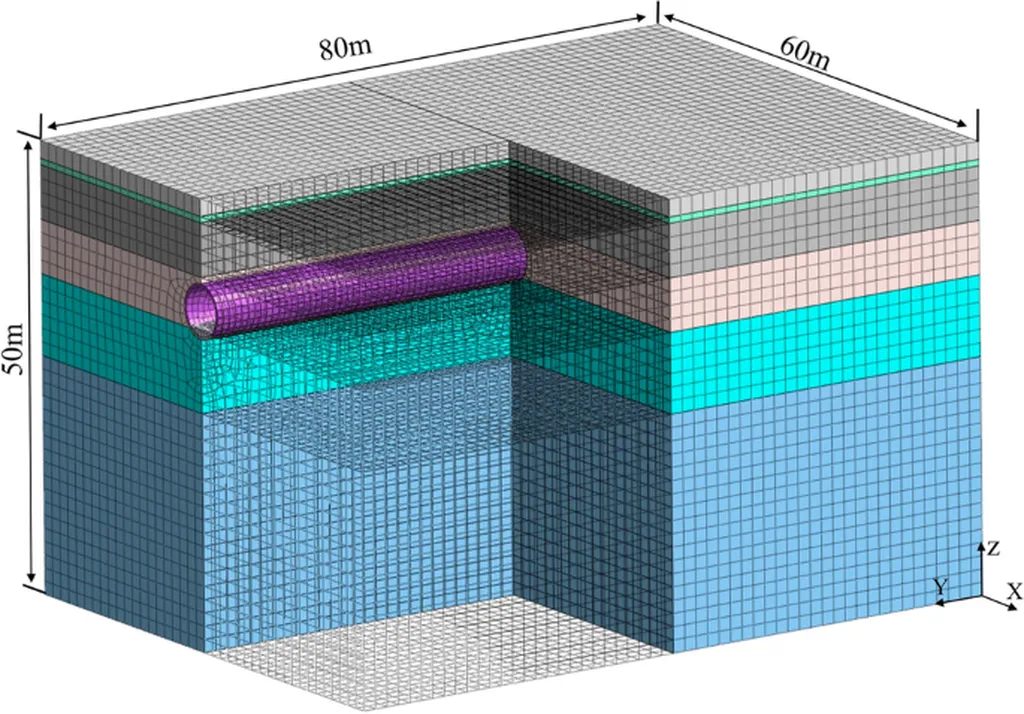
In the bustling metropolis of Shanghai, where the underground network of tunnels is as intricate as the city’s surface infrastructure, a team of researchers has made a significant stride in understanding how these tunnels interact with the soil beneath them. Led by Dr. Liang Fayun from Tongji University’s Department of Geotechnical Engineering, the team has developed a novel approach to determine the nonlinear foundation reaction of shield tunnels, a critical factor in the design and safety of urban underground structures.
The research, published in *Yantu gongcheng xuebao* (Chinese Journal of Geotechnical Engineering), focuses on the subgrade reaction of shield tunnels, which is the resistance offered by the soil to the tunnel’s deformation. This is particularly important under surcharge conditions, such as when heavy loads are applied above the tunnel, like buildings or other structures.
The team’s approach is based on the soil strength design method (MSD method) and the unified hardening model (UH model). Dr. Liang explains, “We’ve proposed a practical simplified version by describing the mechanical properties of the entire soil zone with constitutive curves of soils at the height of the tunnel center.” This simplification allows for more accurate predictions of the soil’s behavior under different loading conditions.
Using statistically derived UH constitutive parameters for soil layers in Shanghai, the team predicted and fitted the subgrade reactions using a hyperbolic curve function. Dr. Wei Shengming, a co-author of the study, notes, “After a secondary fitting process, we obtained the initial stiffness and the ultimate strength related to the parameters of the constitutive model.” This data was then used to establish functions for subgrade reactions of shield tunnels in Shanghai.
The implications of this research are significant for the energy sector, particularly in urban areas where underground infrastructure is crucial. Accurate prediction of tunnel deformation under surcharge can inform better design practices, ensuring the safety and longevity of these structures. As Dr. Liang points out, “The convergence deformation of the tunnels under surcharge is more sensitive to the initial stiffness of subgrade reactions, governed by various soil parameters such as κ/λ and confining pressure, than to its ultimate strength.”
This research could shape future developments in the field by providing a more accurate and efficient method for predicting tunnel behavior. As cities continue to grow and expand underground, understanding these interactions will be crucial for maintaining the safety and integrity of urban infrastructure. The team’s work is a significant step forward in this endeavor, offering valuable insights for engineers and researchers alike.