
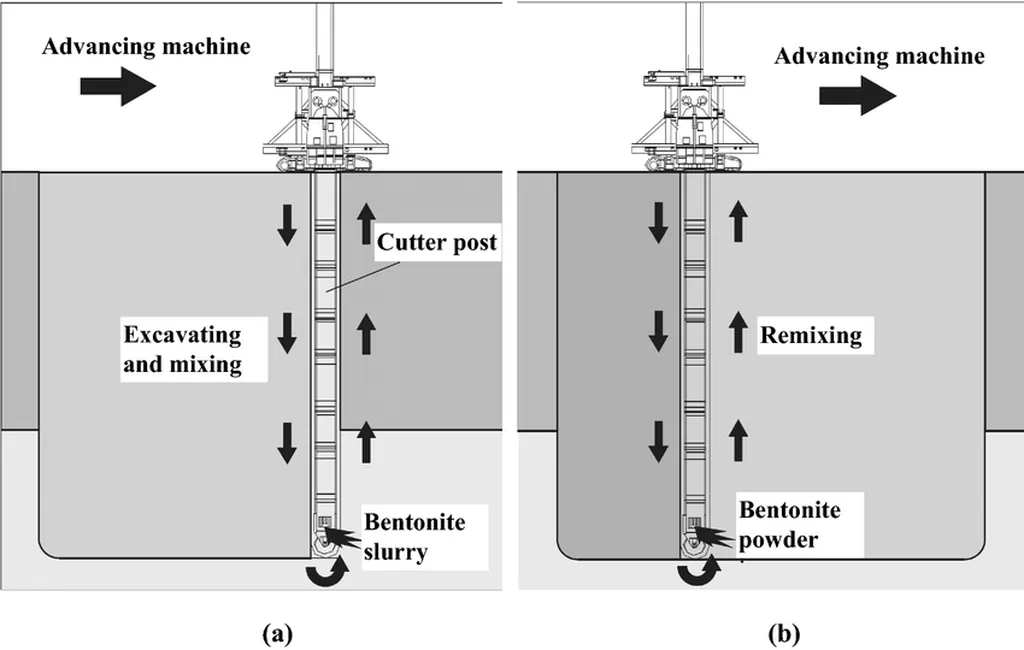
In the quest to optimize cut-off wall construction, a team of researchers from Tongji University has made a significant stride by enhancing the properties of calcium-based bentonite (CaB), a readily available resource in China. Led by Dr. Chen Hongxin from the Department of Geotechnical Engineering, the study focuses on modifying CaB with sodium polyacrylate (PAAS) to improve its swelling capacity and chemical compatibility, crucial factors for effective slurry preparation in cut-off walls.
Cut-off walls are vital in various engineering projects, particularly in the energy sector, where they are used to control groundwater flow and prevent contamination. The traditional use of sodium-based bentonite has been limited by its scarcity and high cost, making the exploration of CaB alternatives a priority. However, natural CaB’s limited swelling capacity and chemical compatibility have posed challenges.
The research, published in *Yantu gongcheng xuebao* (translated as *Rock and Soil Mechanics*), reveals that by modifying CaB with PAAS, the team achieved a 34.0 mL/2g swelling index at an optimal modifier content of 8%. This enhancement significantly improves the water absorption and swelling performance of CaB, addressing key limitations of the natural material.
“Our findings demonstrate that sodium polyacrylate modification not only enhances the swelling capacity of calcium-based bentonite but also improves its chemical compatibility,” said Dr. Chen. “This modification process opens up new possibilities for the practical application of CaB in cut-off wall construction.”
The study also highlights the impact of PAAS content on slurry properties. As the PAAS content increases, the Marsh viscosity of the slurry rises, while the filtration loss and pH value decrease. The slurry density, however, is primarily controlled by the bentonite content. These insights provide valuable guidance for optimizing slurry preparation in field applications.
At a microscopic scale, PAAS-modified CaB (PAAS―CaB) exhibits a superior overall lamellar structure with a smaller interlayer distance of montmorillonite crystalline layers compared to unmodified CaB. The modification primarily occurs through bridging encapsulation and graft copolymerization, enhancing the material’s overall performance.
The commercial implications of this research are substantial, particularly for the energy sector. The enhanced engineering properties of PAAS―CaB can lead to more efficient and cost-effective construction of cut-off walls, crucial for projects such as dams, landfills, and underground storage facilities. The use of locally available CaB resources can also reduce dependency on imported sodium-based bentonite, lowering costs and improving sustainability.
“This research establishes a reliable foundation for optimizing the preparation process of PAAS―CaB and presents a feasible technical pathway for the engineering application of calcium-based bentonite,” said Dr. Chen. “It paves the way for future developments in the field, offering a more sustainable and economically viable solution for cut-off wall construction.”
As the energy sector continues to evolve, the demand for efficient and environmentally friendly construction materials grows. The findings from this study not only address current challenges but also set the stage for future innovations in geotechnical engineering. By leveraging the enhanced properties of PAAS―CaB, engineers can achieve more robust and reliable cut-off walls, contributing to the overall stability and safety of energy infrastructure.