
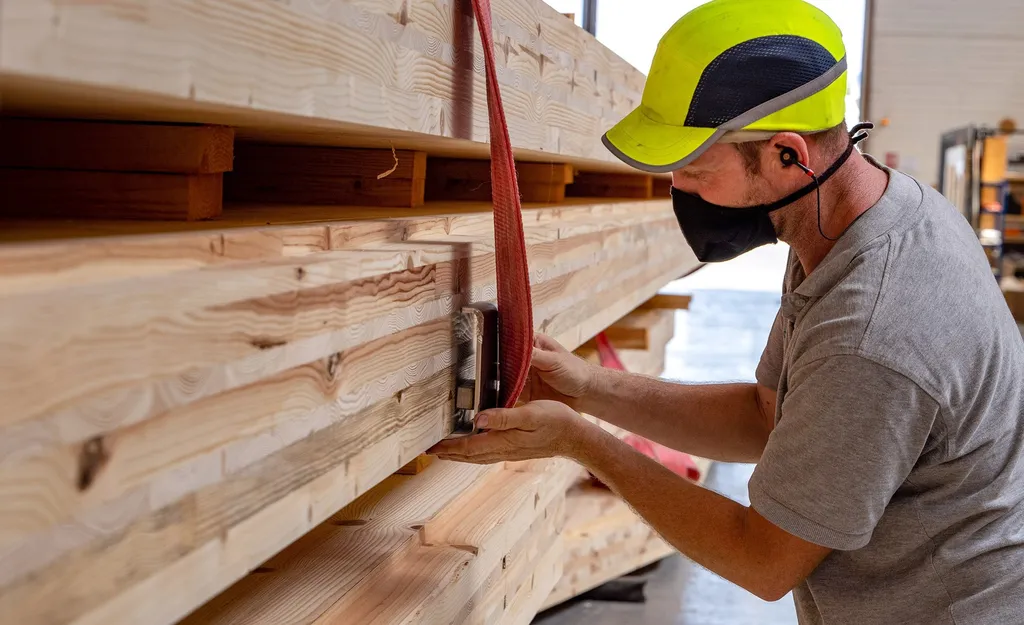
In the ever-evolving world of construction materials, a recent study is making waves by exploring the potential of composite wooden beams connected by TGK dowel plates. This innovative approach, which combines strength and cost-efficiency, could significantly impact the building and energy sectors. The research, led by Isupov Sergei from Vyatka State University, was recently published in the Magazine of Civil Engineering (Журнал Строительной Механики).
Composite wooden beams, made of two balks connected by TGK dowel plates, are gaining traction in the construction industry due to their high strength and rigidity at a relatively low cost compared to traditional glued beams. However, their performance under short-term loading has not been extensively studied—until now.
Sergei and his team set out to confirm the operational strength and rigidity of these composite beams, as well as to analyze their stress-strain state under different types of force and shear tie arrangements. To achieve this, they conducted a series of experiments on beams of varying lengths and configurations, subjecting them to transverse loads.
“The results were quite convincing,” Sergei explained. “We tested the beams under a wide range of applied forces, and the safety factor fluctuated within 2.13 to 3.95. This indicates a robust performance that could be highly beneficial for various construction applications.”
The team also performed calculations using both linear and nonlinear diagrams of joint deformation. The difference between the experimental and theoretical values of deflections was within 20%, which, according to Sergei, “quite convincingly confirms the validity of the theoretical calculations.”
So, what does this mean for the construction and energy sectors? Composite wooden beams with TGK dowel plate connections could offer a more cost-effective and efficient alternative to traditional materials. This could lead to significant savings in building and infrastructure projects, as well as a reduced environmental impact due to the use of wood.
Moreover, the energy sector could benefit from the use of these composite beams in the construction of energy-efficient buildings. The high strength and rigidity of these beams could contribute to the creation of structures that are not only cost-effective but also energy-efficient, helping to reduce overall energy consumption.
As the construction industry continues to seek innovative and sustainable solutions, the research conducted by Sergei and his team could pave the way for the wider adoption of composite wooden beams with TGK dowel plate connections. This could potentially revolutionize the way we build, making structures stronger, more cost-effective, and more environmentally friendly.
In the words of Sergei, “This research is just the beginning. There is still much to explore and understand about these composite beams, but the potential is immense.” As the industry continues to evolve, the insights gained from this study could shape the future of construction and energy efficiency.