
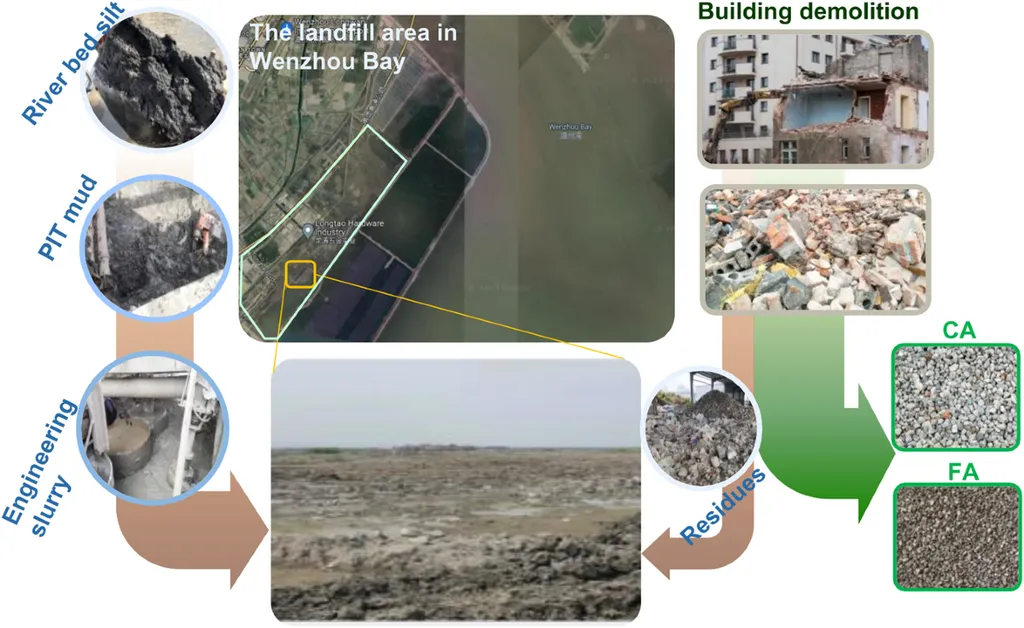
In the realm of construction and environmental engineering, a groundbreaking study led by Dr. Wang Jun from Wenzhou University has unveiled a novel approach to tackle the challenges posed by dredged sludge, offering promising implications for the energy sector and coastal developments. The research, published in *Yantu gongcheng xuebao* (translated as *Chinese Journal of Geotechnical Engineering*), introduces a combined method that integrates grouting flocculation and vacuum preloading, aiming to enhance the consolidation of dredged sludge.
Dredged sludge, a byproduct of dredging activities, often presents significant hurdles due to its poor permeability and prolonged consolidation time. Traditional methods have struggled to address these issues effectively. However, the innovative approach proposed by Dr. Wang and his team offers a potential solution. “Our study demonstrates that by combining grouting flocculation with vacuum preloading, we can significantly improve the consolidation process of dredged sludge,” Dr. Wang explained. This method not only accelerates the consolidation time but also mitigates the adverse effects of soil salinization, a critical factor in coastal and wetland restoration projects.
The research involved conducting indoor model tests on dredged sludge with varying initial water contents, controlling different lime contents to monitor changes in pore water pressure, displacement, and settlement. Post-test measurements included pH, salinity, water content, and vane shear strength of the soil. The findings revealed that the optimal lime content, considering both strength growth and soil salinization, could be determined for the grouting flocculation-vacuum preloading method.
The practical application of this combined method was further validated through its successful implementation in the Longwan Phase Ⅱ coastal wetland restoration project. This success underscores the potential of the method to be applied in similar projects, offering a more efficient and effective solution for managing dredged sludge.
The implications of this research extend beyond environmental engineering, particularly for the energy sector. Coastal and wetland areas are often sites for renewable energy projects, such as wind farms and tidal energy installations. Efficient consolidation of dredged sludge can facilitate the construction of stable foundations for these energy infrastructure projects, reducing costs and environmental impact.
Dr. Wang’s research highlights the importance of interdisciplinary collaboration in addressing complex engineering challenges. By integrating geotechnical engineering principles with environmental considerations, the study paves the way for more sustainable and efficient practices in the construction and energy sectors. As Dr. Wang noted, “This research not only advances our understanding of dredged sludge consolidation but also offers practical solutions that can be implemented in real-world projects, benefiting both the environment and the economy.”
The findings published in *Yantu gongcheng xuebao* provide a valuable reference for engineers and researchers working on similar projects, offering insights into the optimal use of grouting flocculation-vacuum preloading methods. As the energy sector continues to expand into coastal and wetland areas, the need for innovative solutions to manage dredged sludge will only grow. This research represents a significant step forward in meeting that need, shaping the future of construction and environmental engineering practices.